The Midnight Hour
Location: Catalina Island
Site: The Midnight Hour
Boat: Giant Stride
Net Retrieval: Curtis Wolfslau, Rene Tetter, Andrew Hung, Juan Torres
Documentation: Norbert Lee, Daniel Pio
Surface Support: Angie Biggs, Jeremy Jodoin
Mission Impact: 300 pounds of net removed (approximately 700 square feet) and delivered to Aquafil for recycling.
Ghost Diving USA set out aboard the Giant Stride to continue our cleanup of the site we call the Midnight Hour. Back in May, our team cut and staged bunches of net at the site for a future recovery. This month’s objective was to finish what we started, cutting the prepared net free and raise it to the surface.
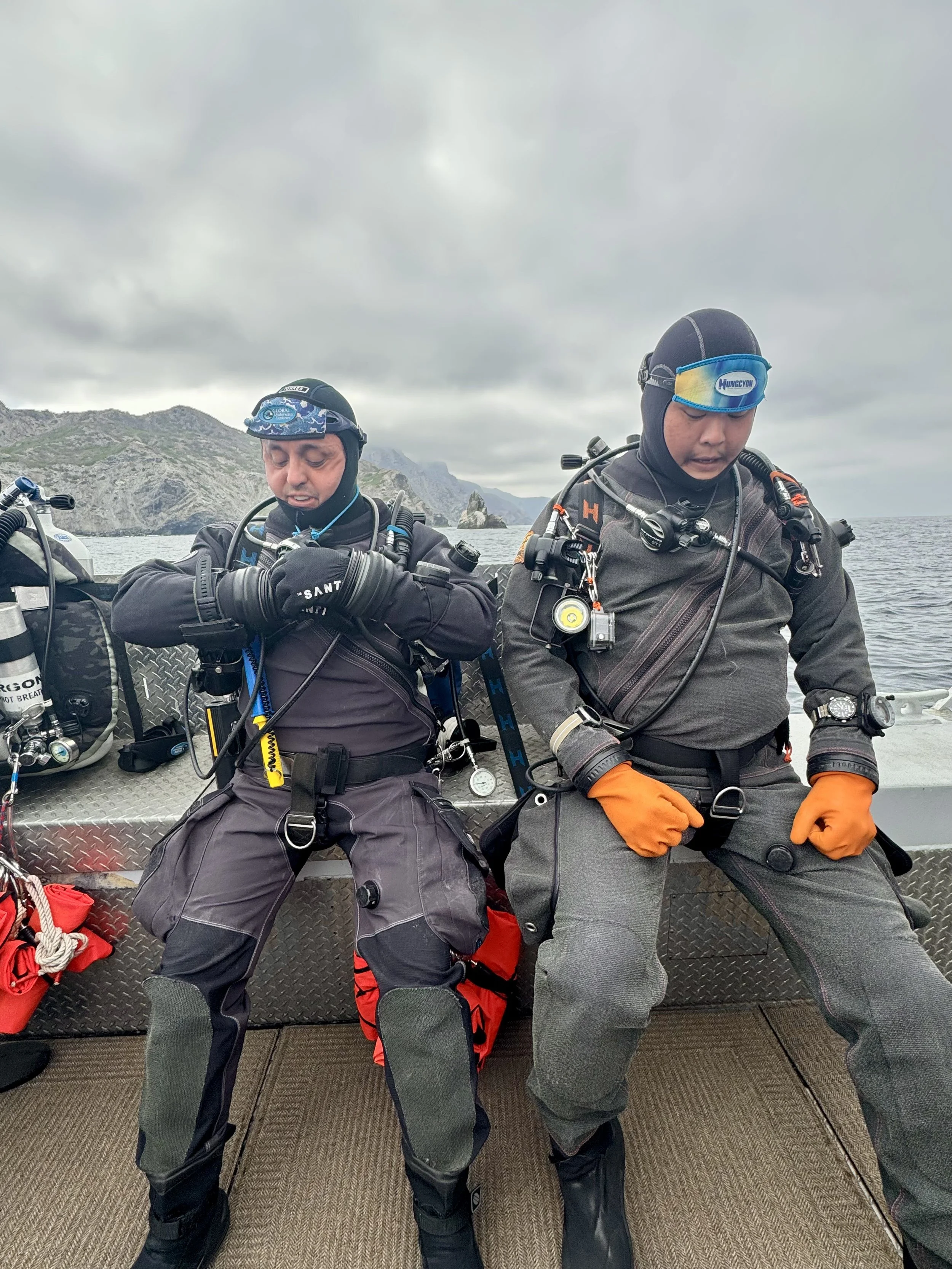
Andrew and Juan gearing up as we approached the site.
Topside conditions were sunny with a mild wind, and after a thorough briefing the team geared up and dropped in. Below, the divers were met with a strong current and roughly 30 feet of visibility.
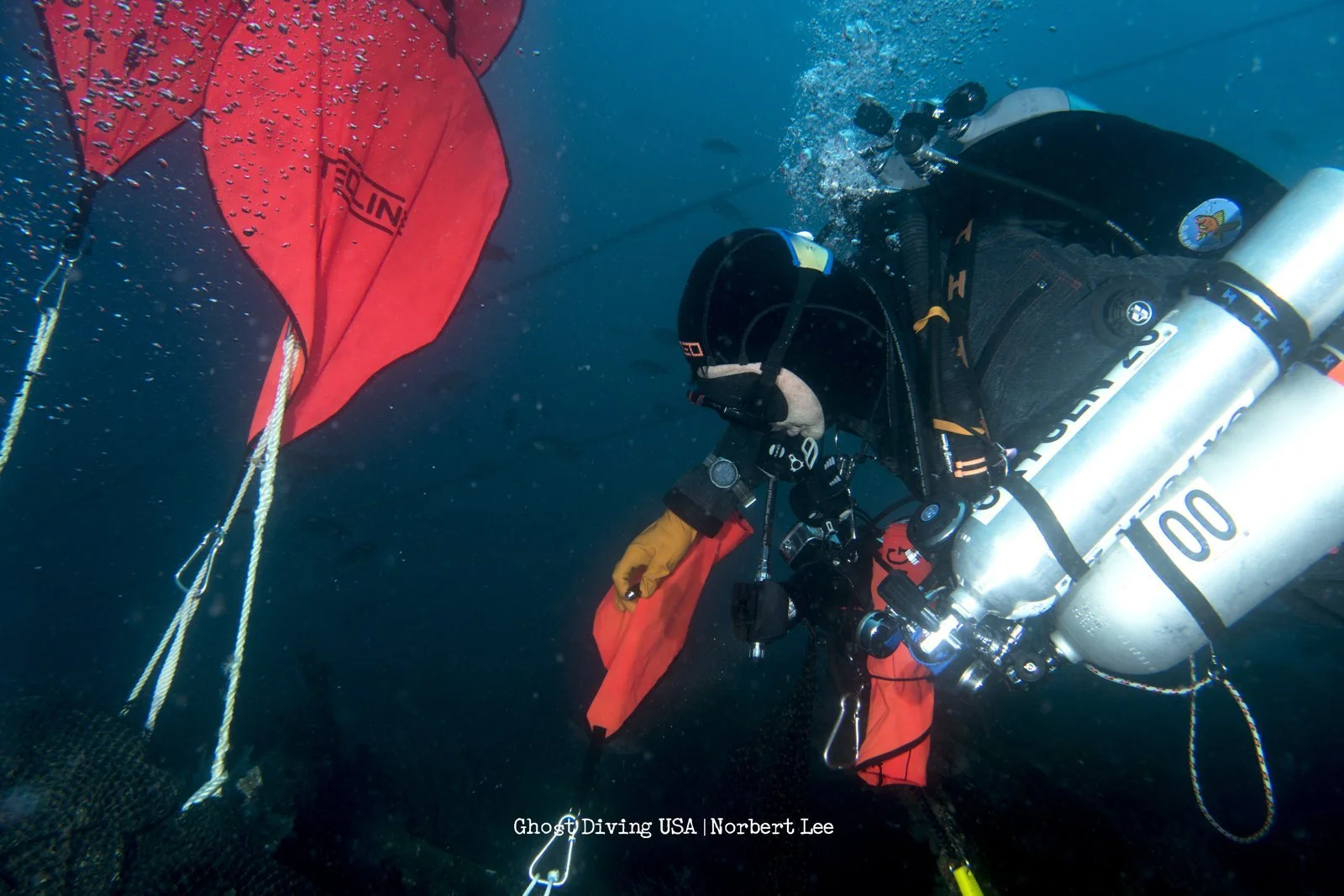
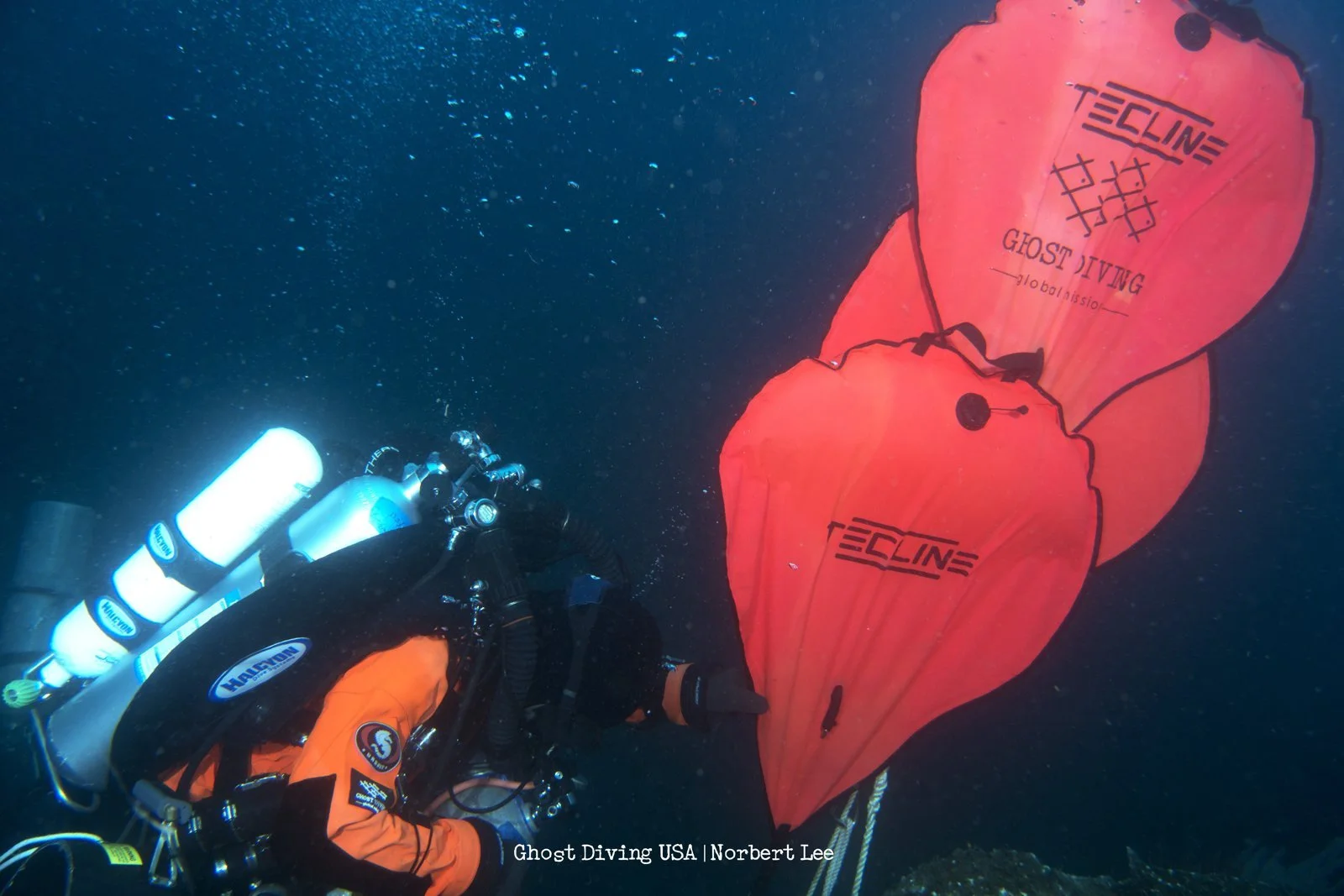
On the bottom, the team located the staged net and went to work, cutting sections free, attaching lift bags, and sending them toward the surface. As always, our divers checked the net carefully for entangled marine life as they cut.
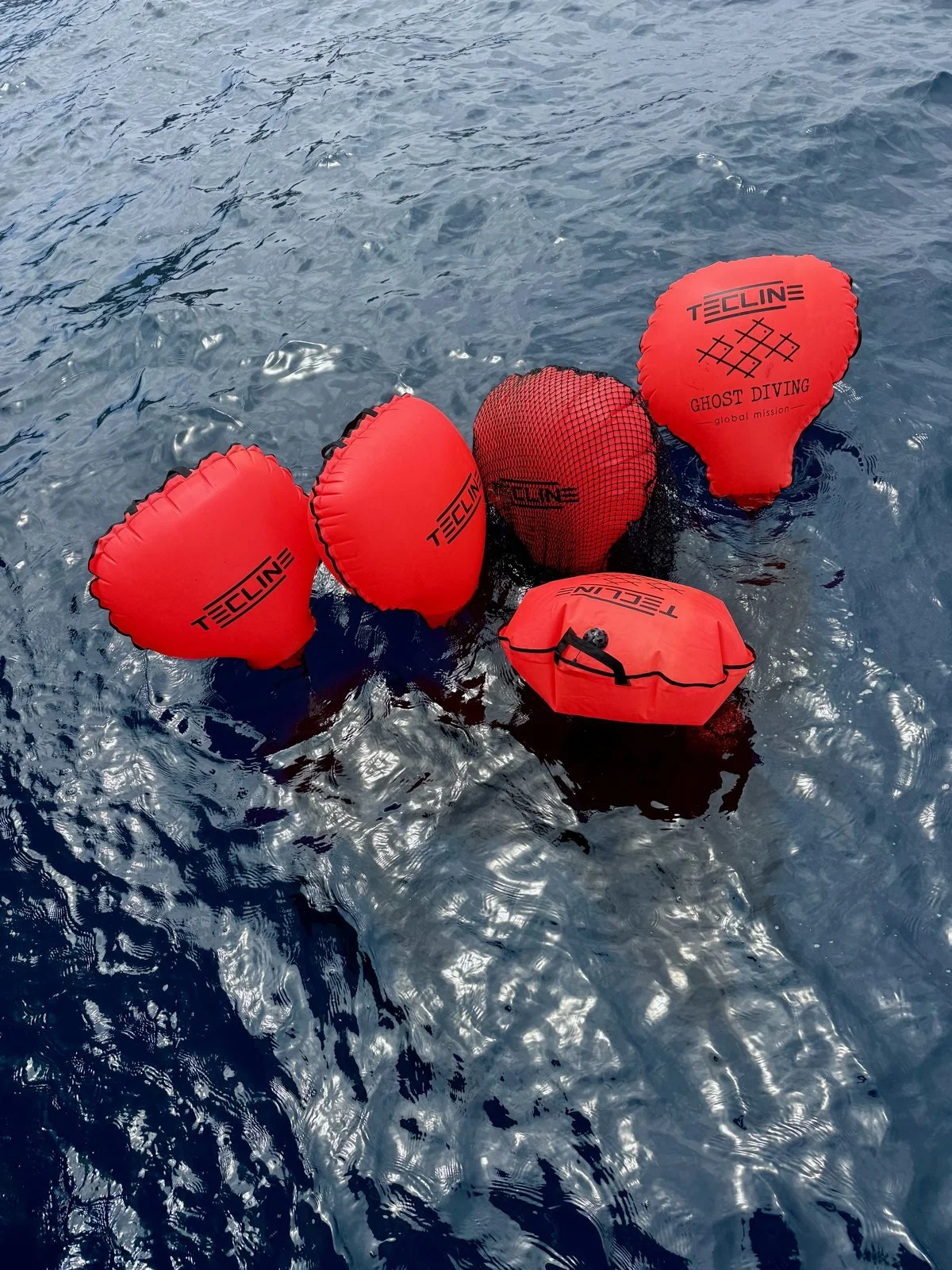
At the surface, Angie, Jeremy, and the crew of the Giant Stride hauled the net aboard. When the day was tallied, the team had raised three large sections, roughly 300 pounds and approximately 700 square feet of ghost net. That is 300 pounds of net that can no longer entangle and kill marine life, now on its way to Aquafil to be recycled and given a second life rather than left to fish forever on the bottom.
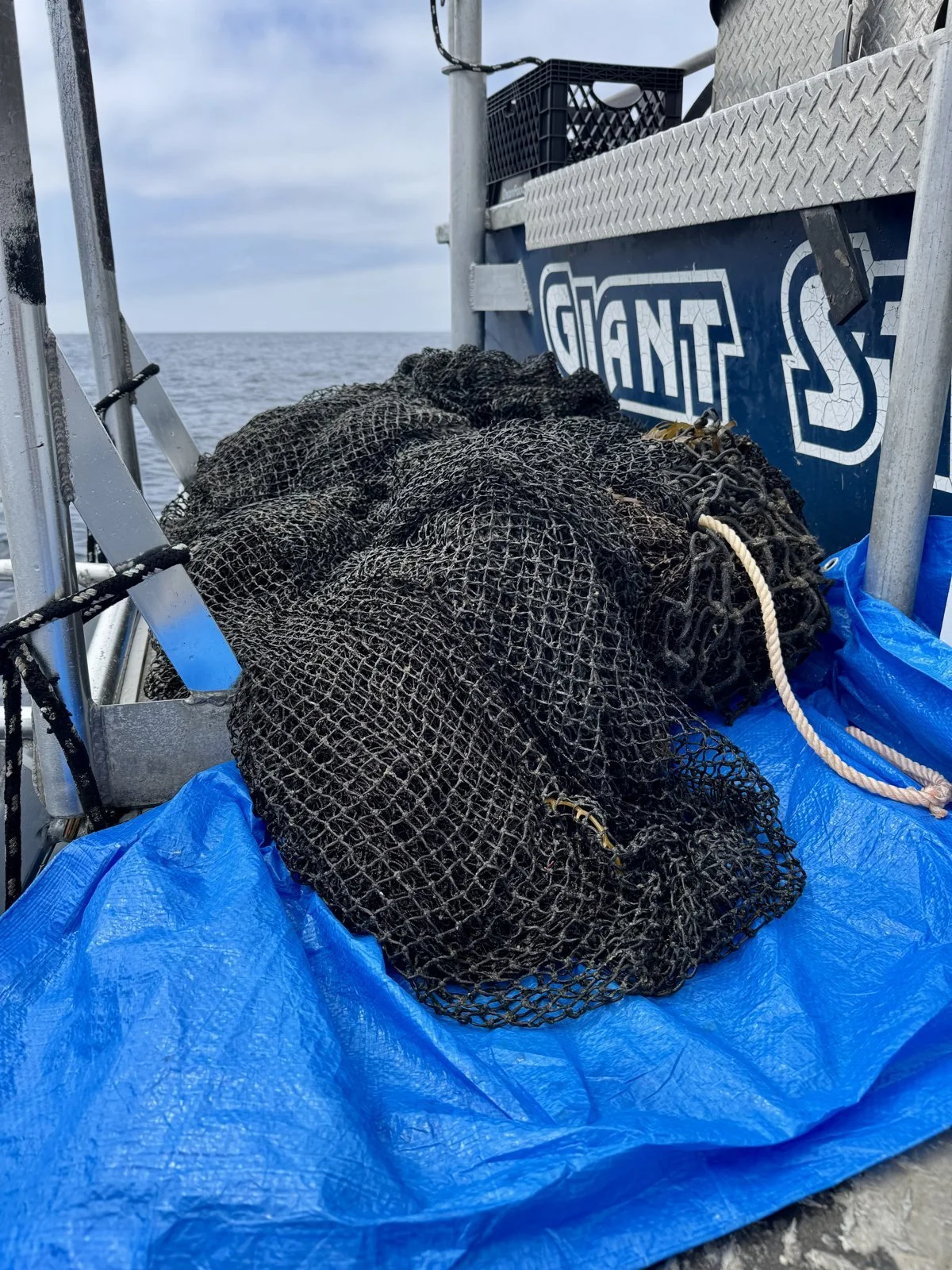
Significant net remains at the site, but it is clearing up with every trip. A great day for the team and another meaningful dent in the ghost gear off our coast. We will be back for the Midnight Hour.
A very special thank you to the crew of the Giant Stride, and to our partners at Healthy Seas, Hyundai USA, and Aquafil for supporting our clean-up efforts.
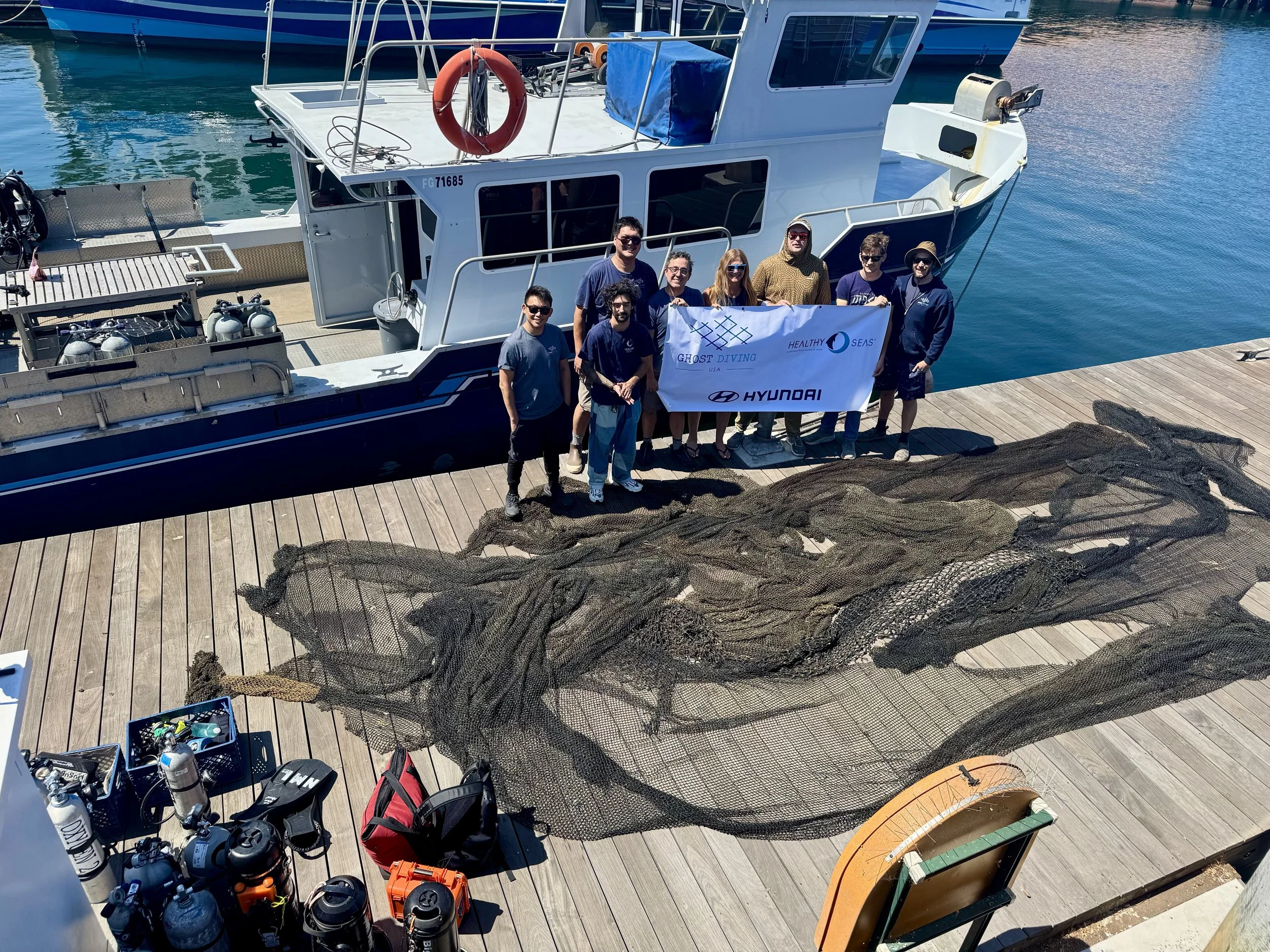
Back at the dock — 700 square feet of ghost net headed for recycling.
The Midnight Hour
The Midnight Hour
Location: Catalina Island
Site: The Midnight Hour
Team 1: Jim Babor, Andrew Hung, Juan Torres
Surface Support: Katie McWilliams
Mission Impact: Site surveyed, net located, assessed, and marked for a future recovery mission.
Not every mission is about what we pull out of the water that day. Team Ghost Diving USA set out for the site we call the Midnight Hour with a different objective: to scout and prepare it for a future mission where we intend to recover a substantial amount of net.
Preparation dives are some of the most valuable work we do. Before a major net recovery, our team needed to prepare the site, cut cables securing the net to the wreck and stage lines for the following cleanup.
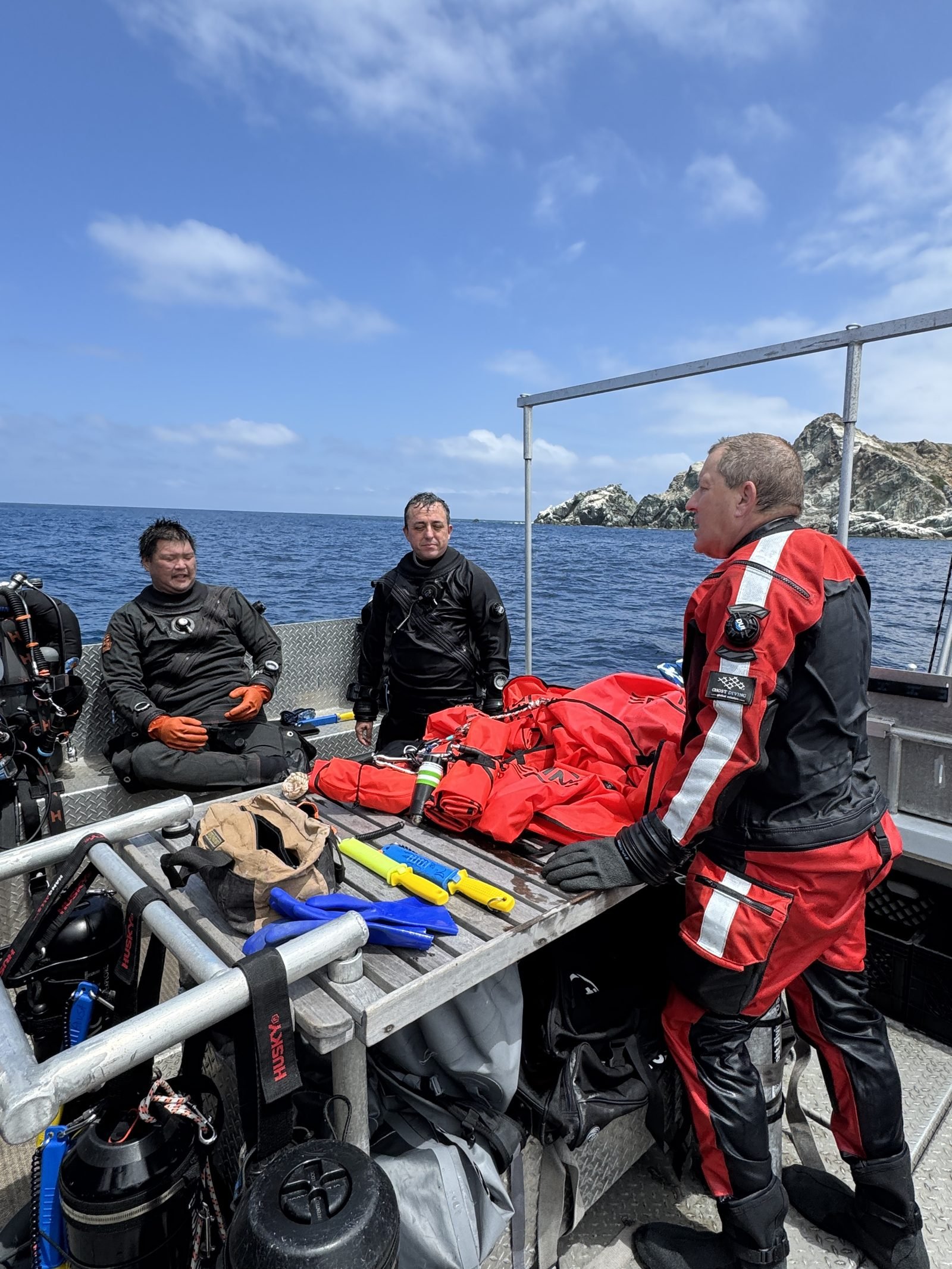
Divers gearing up on deck as we approached the site.
Conditions topside were in our favor and the team made quick work of gearing up. With a clear plan for the day, divers entered the water to begin the survey.
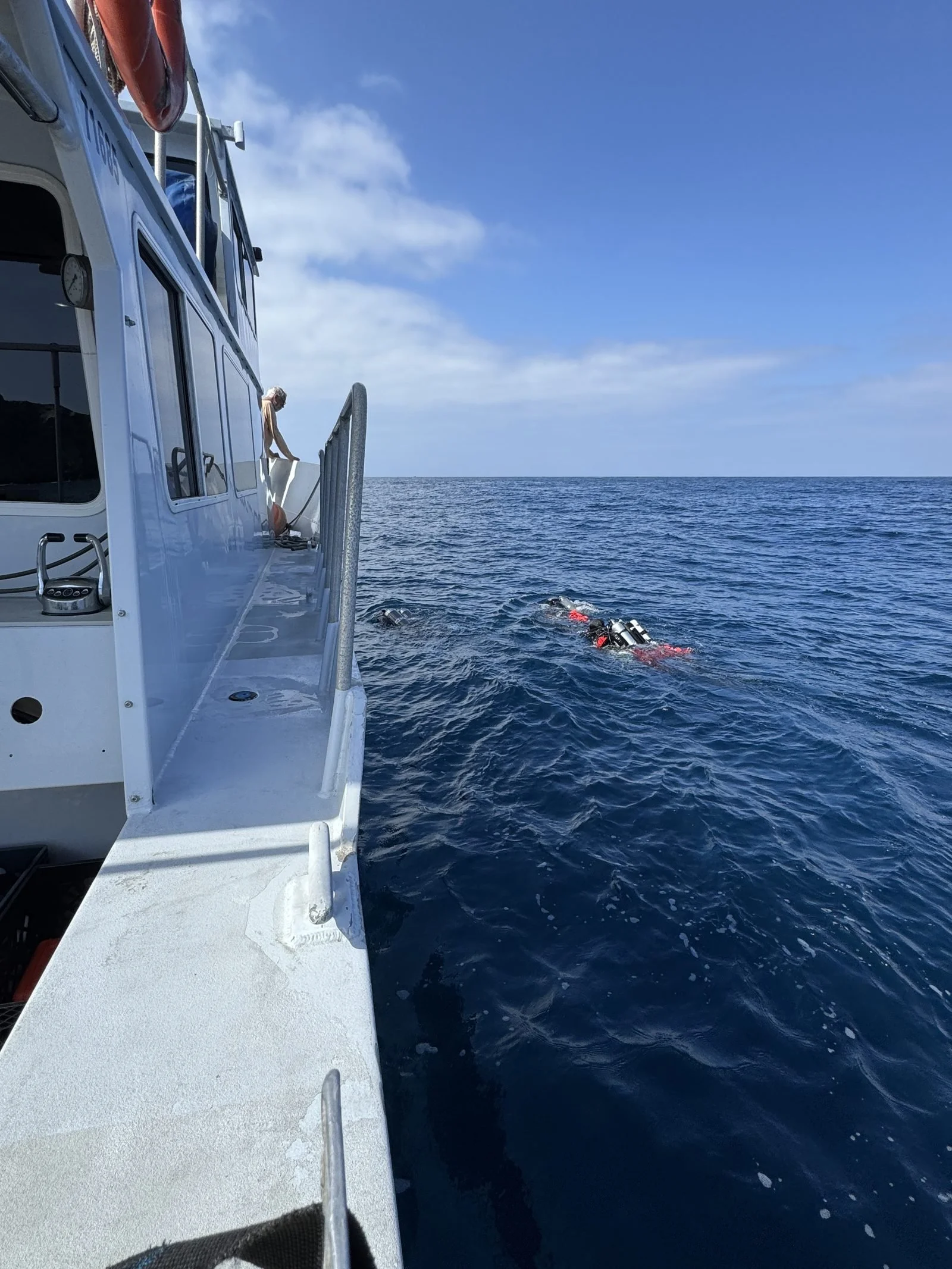
Divers work the surface before descending to assess the site.
Once down, the team located the net and went to work documenting it, sizing up the section, noting how it sat on the structure, and identifying the best approach for cutting and lifting it on a future dive. As always, our divers checked the net for entangled marine life as they worked. The site was marked so we can return directly to it, and the team captured photo and 360 video to brief the recovery teams.
A very special thank you to our partners at Healthy Seas and Hyundai USA for supporting our clean-up efforts.
The Midnight Hour
Location: Southern California
Site: The Midnight Hour
Boat: Giant Stride
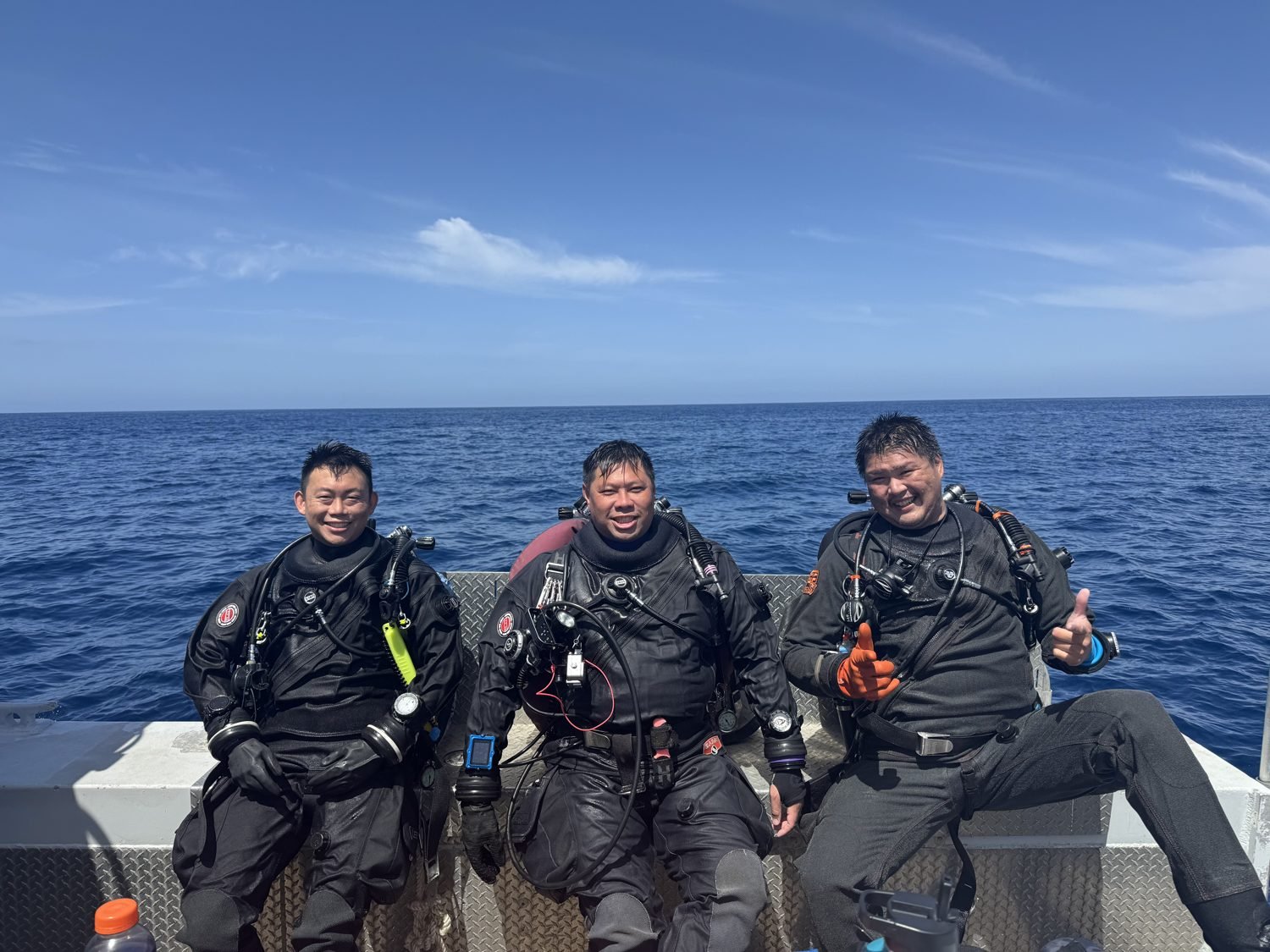
Divers: Curtis Wolfslau, Andrew Hung, Norbert Lee, Jung Hseih
Surface Support: Angie Biggs
Mission Impact: 200 pounds of net removed (approximately 400 square feet) and sent to Aquafil for recycling.
Team Ghost Diving USA set out aboard the Giant Stride for the Midnight Hour. With scooters charged, decompression gas staged, and a clear plan for the day, the team came ready to pull net.
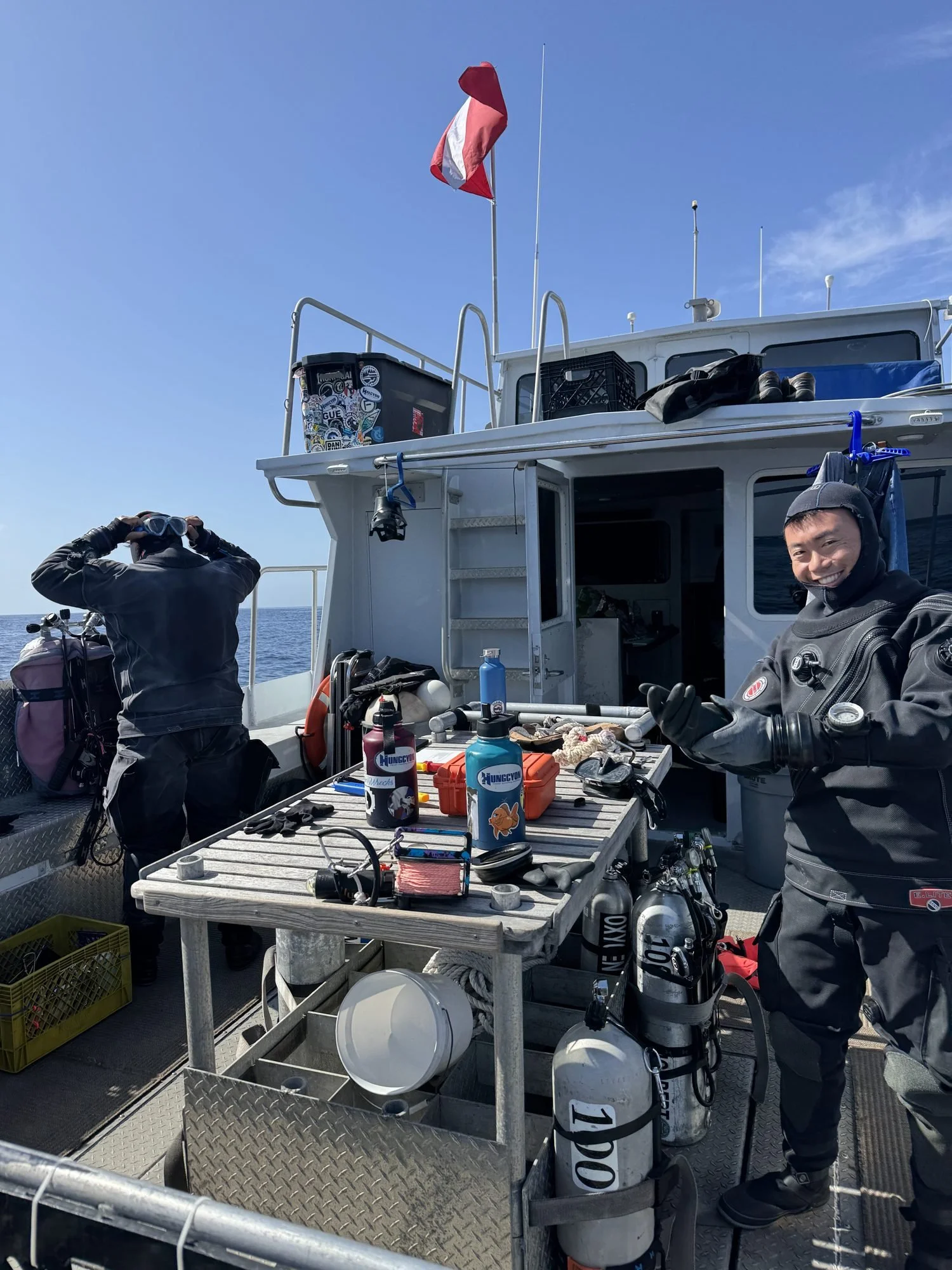
Gearing up on deck under the dive flag, stage bottles staged and ready.
After a thorough briefing, the team geared up and dropped in. On the bottom, the divers located the net and went to work — placing lift bags, cutting the net free, and inflating the bags to carry it toward the surface. As always, our team checked the net carefully for entangled marine life as they cut.
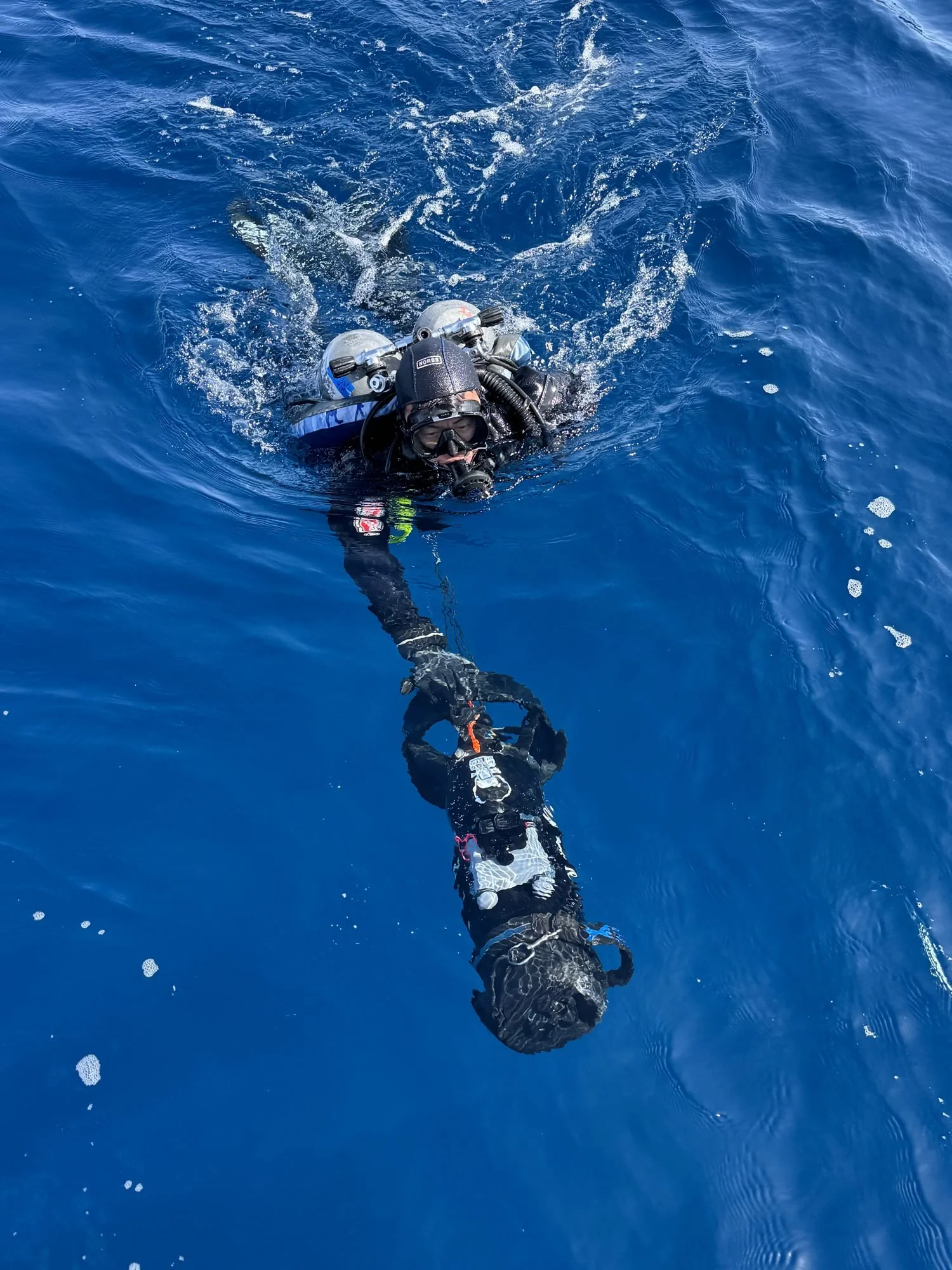
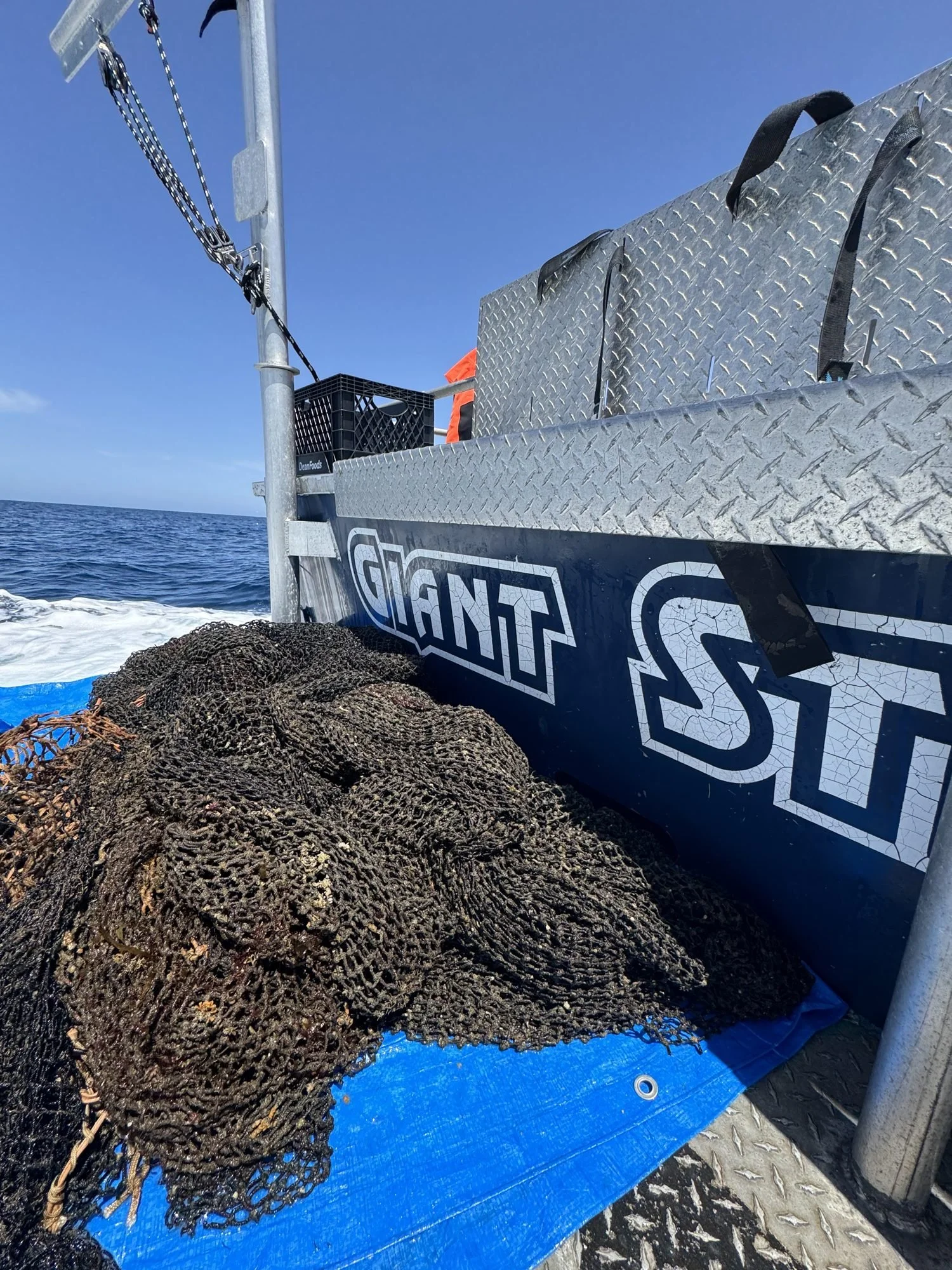
At the surface, Angie and the crew of the Giant Stride were ready to retrieve the net and haul it aboard. When the net was tallied, the team had removed roughly 200 pounds — about 400 square feet — of ghost net from the site. That is 200 pounds of net that can no longer entangle and kill marine life. The recovered net was sent to Aquafil to be recycled and given a second life rather than left to fish forever on the bottom.
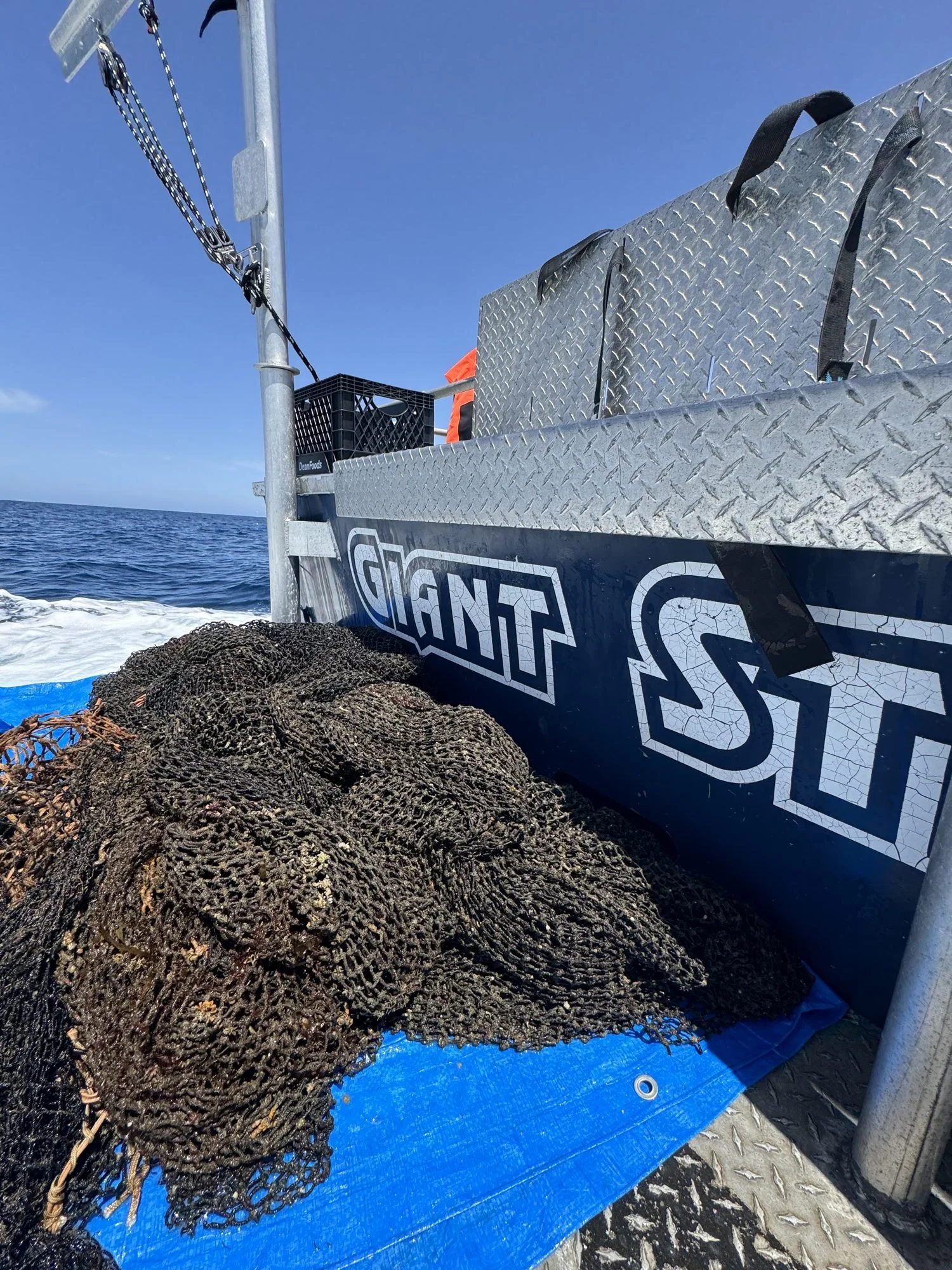
The day’s haul — net piled on the deck of the Giant Stride.
A great day for the team and another meaningful dent in the ghost gear off our coast. We will be back for the Midnight Hour.
A very special thank you to Captain Jim and the crew of the Giant Stride, and to our partners for supporting our clean-up efforts.
The Midnight Hour
Location: Southern California
Site: The Midnight Hour
Boat: Giant Stride
Divers: Jim Babor, Juan Torres, Norbert Lee, Nir Maimon
Documentation: Daniel Pio
Surface Support: Curtis Wolfslau
Mission Impact: 2 large sections of net removed — approximately 500 pounds (about 1,000 square feet) — and delivered to Aquafil for recycling.
Team Ghost Diving USA returned to the Midnight Hour aboard the Giant Stride, back at the site to remove the net we had found previously on a scouting mission. The plan was straightforward and ambitious: rig large sections of net, lift them, and bring them home.
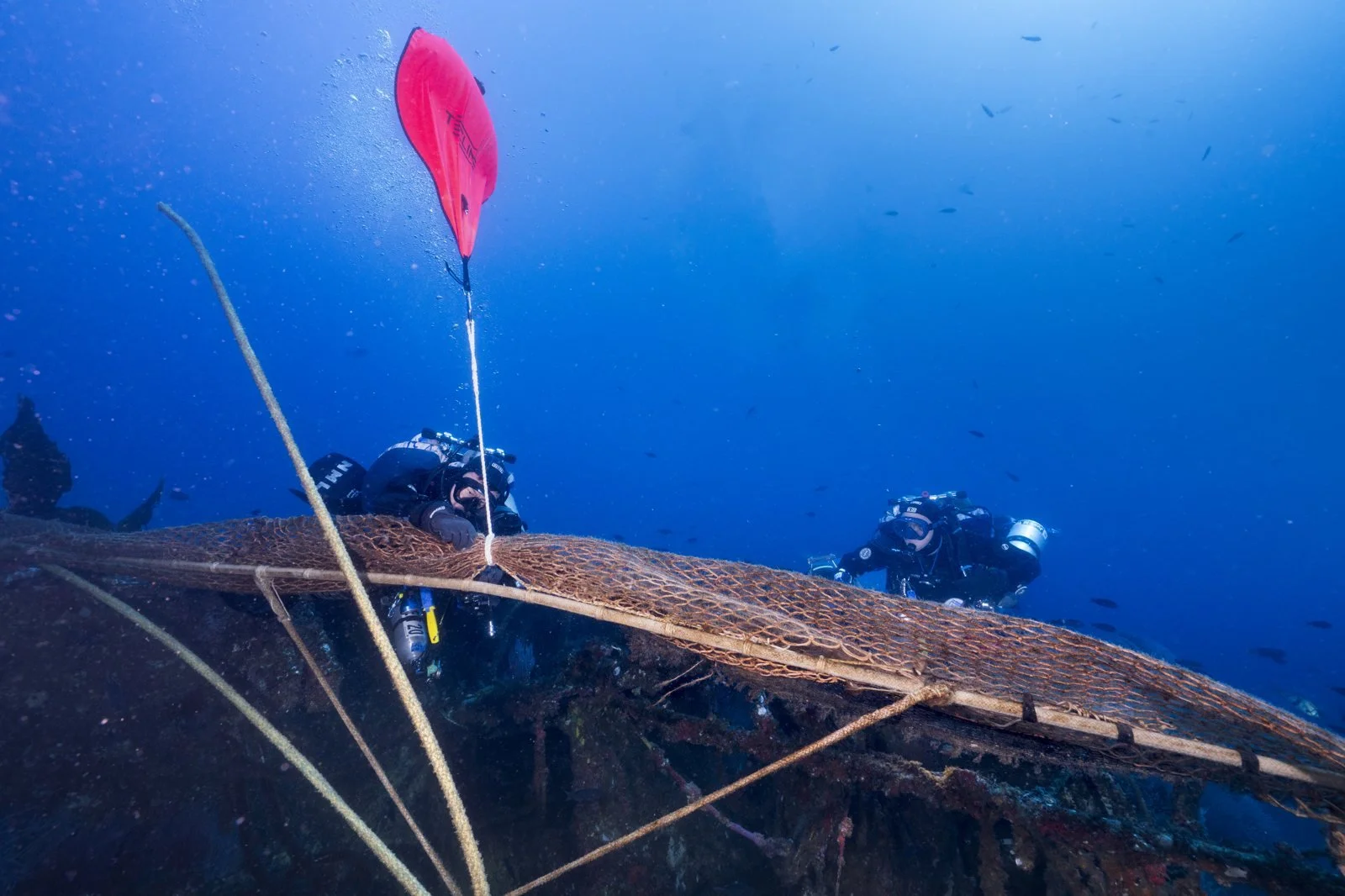
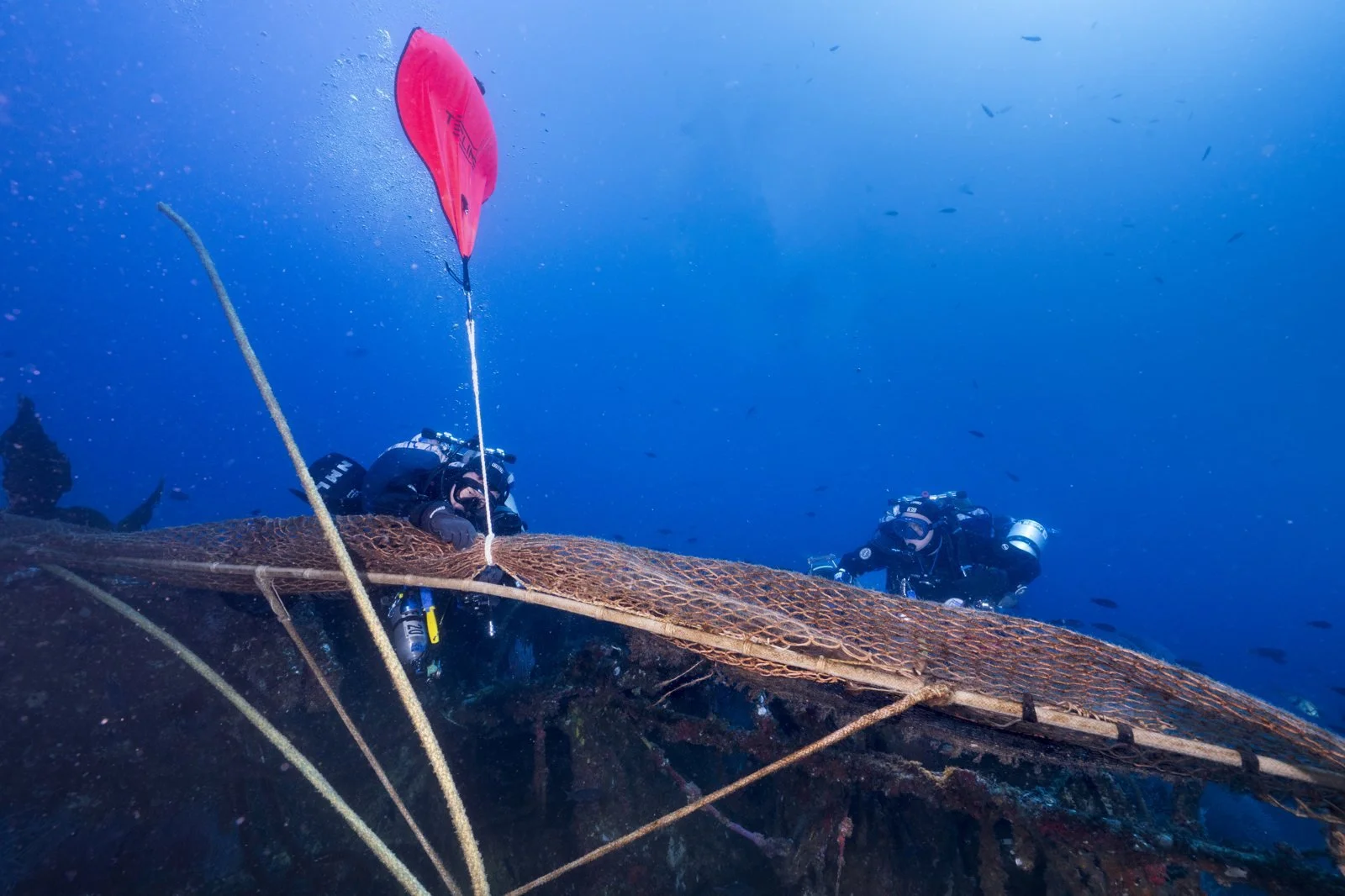
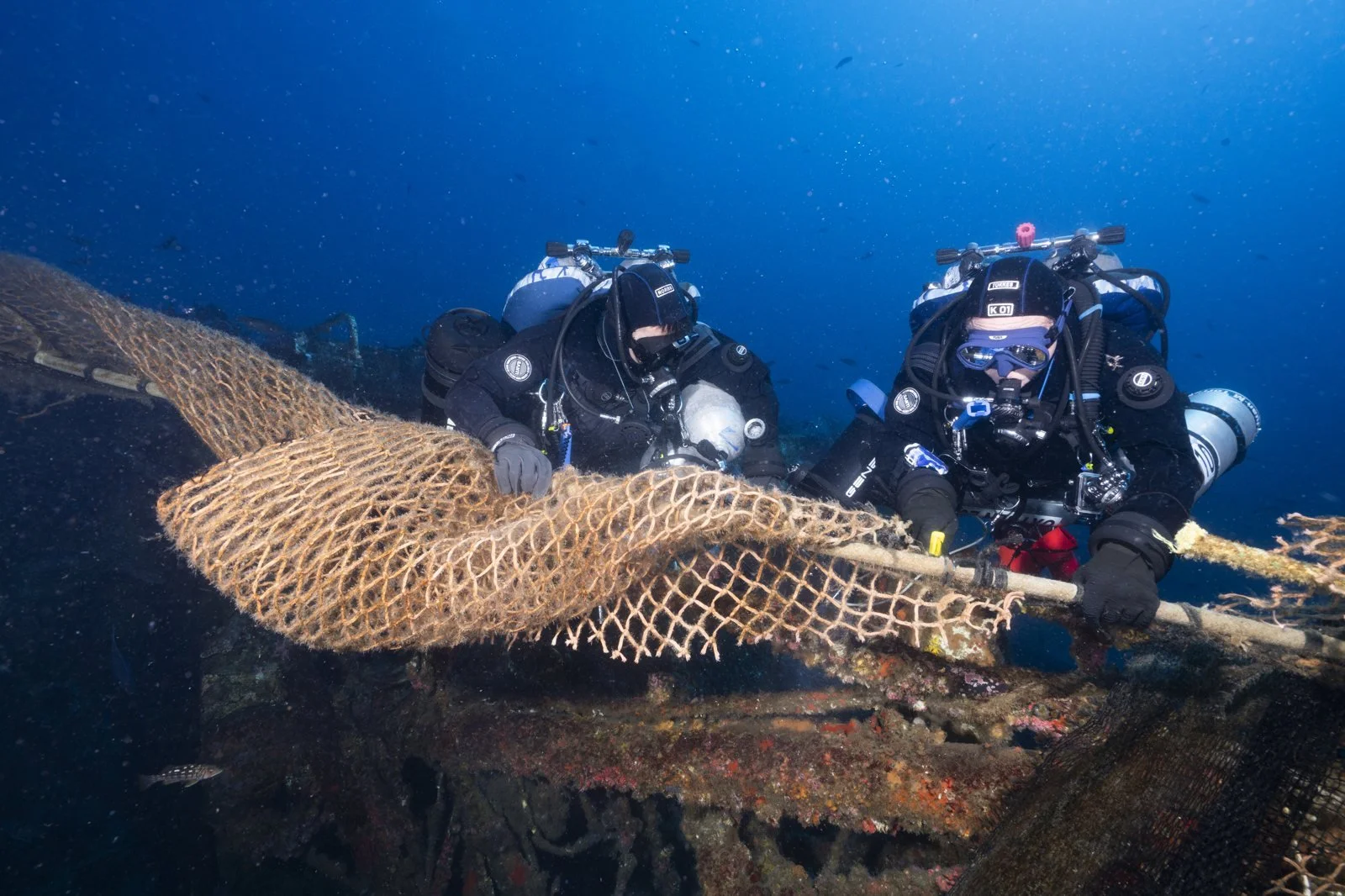
The net on the midnight hour has likely unrolled from the large spool that is on the wreck during a recent storm. We focused on cleaning the portions that are most dangerous to marine life and is draping across the wreck.
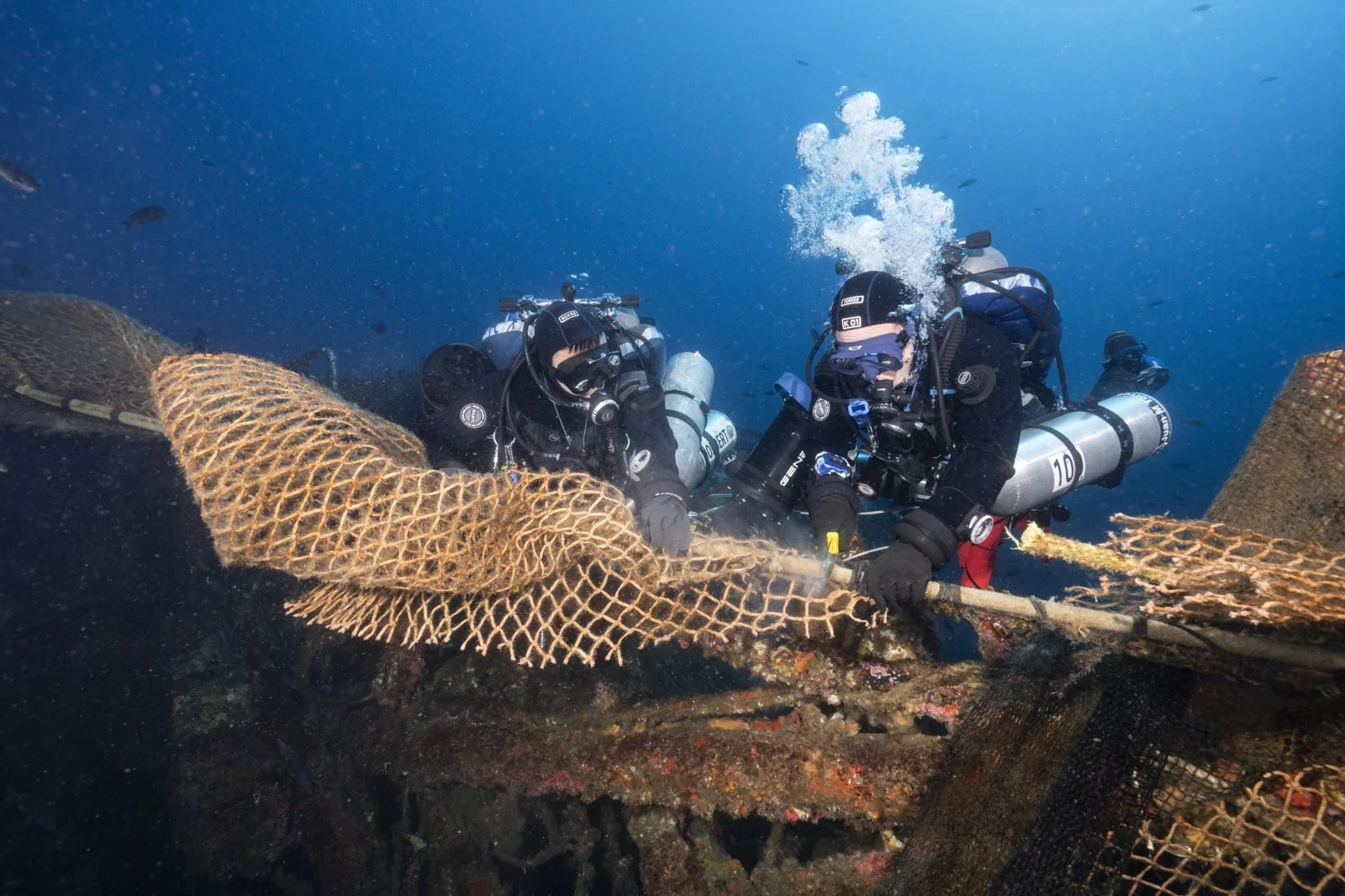
Divers work a large section of net spread across the wreck.
As always, our divers checked the net carefully for entangled marine life as they cut. Section by section, they freed the net from the wreck, clipped on lift bags, and sent it on its way to the surface.
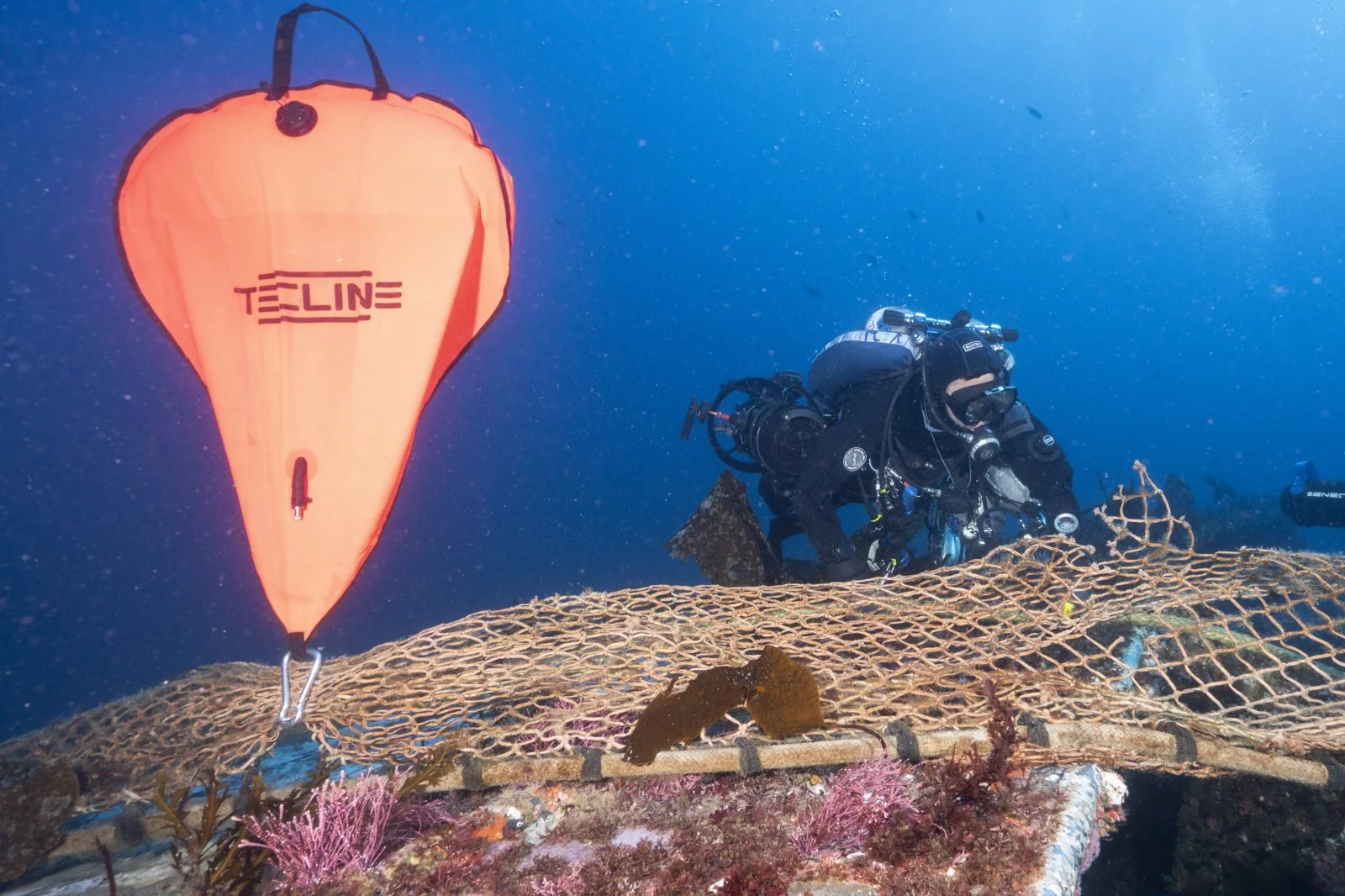
A lift bag carries a section of net up off the wreck.
Topside, the crew of the Giant Stride hauled the net aboard. When it was all tallied, the team had removed two large sections of net — roughly 500 pounds and about 1,000 square feet — one of our bigger single-day hauls at the site.
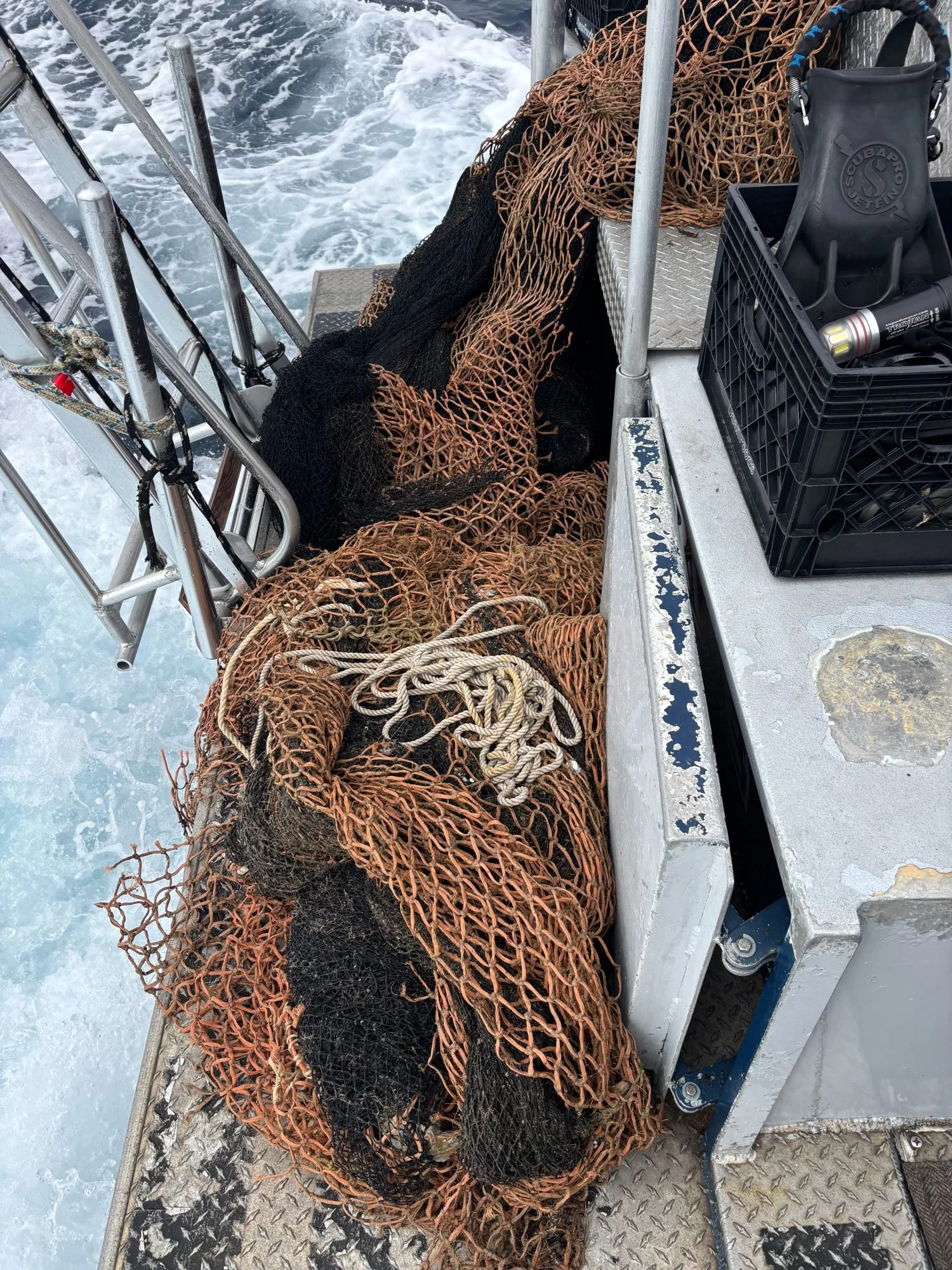
The day’s haul aboard the Giant Stride.
From the dock, the net went straight to Aquafil, where recovered nets are recycled and regenerated into new material rather than left to fish the wreck forever. That is the full circle we aim for on every clean-up: net out of the ocean and back into use.
Net delivered to Aquafil for recycling.
A big day and a big haul for the team — and there is still more waiting for us at the Midnight Hour.
A very special thank you to Captain Jim and the crew of the Giant Stride, to Daniel Pio for the underwater photography, and to our partners at Healthy Seas and our sponsors for supporting our clean-up efforts.
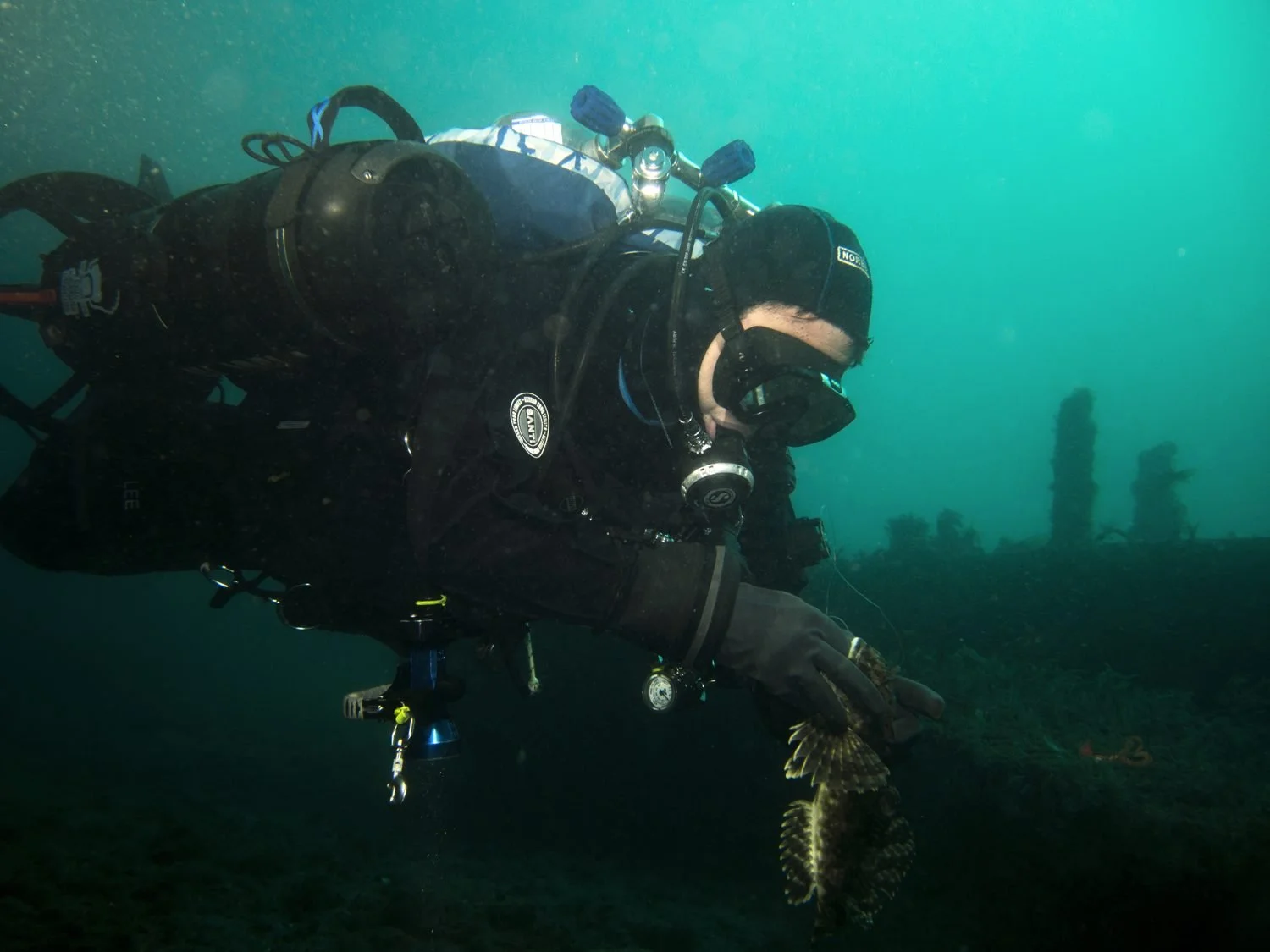
The African Queen
Ghost Diving USA · 1/24/26
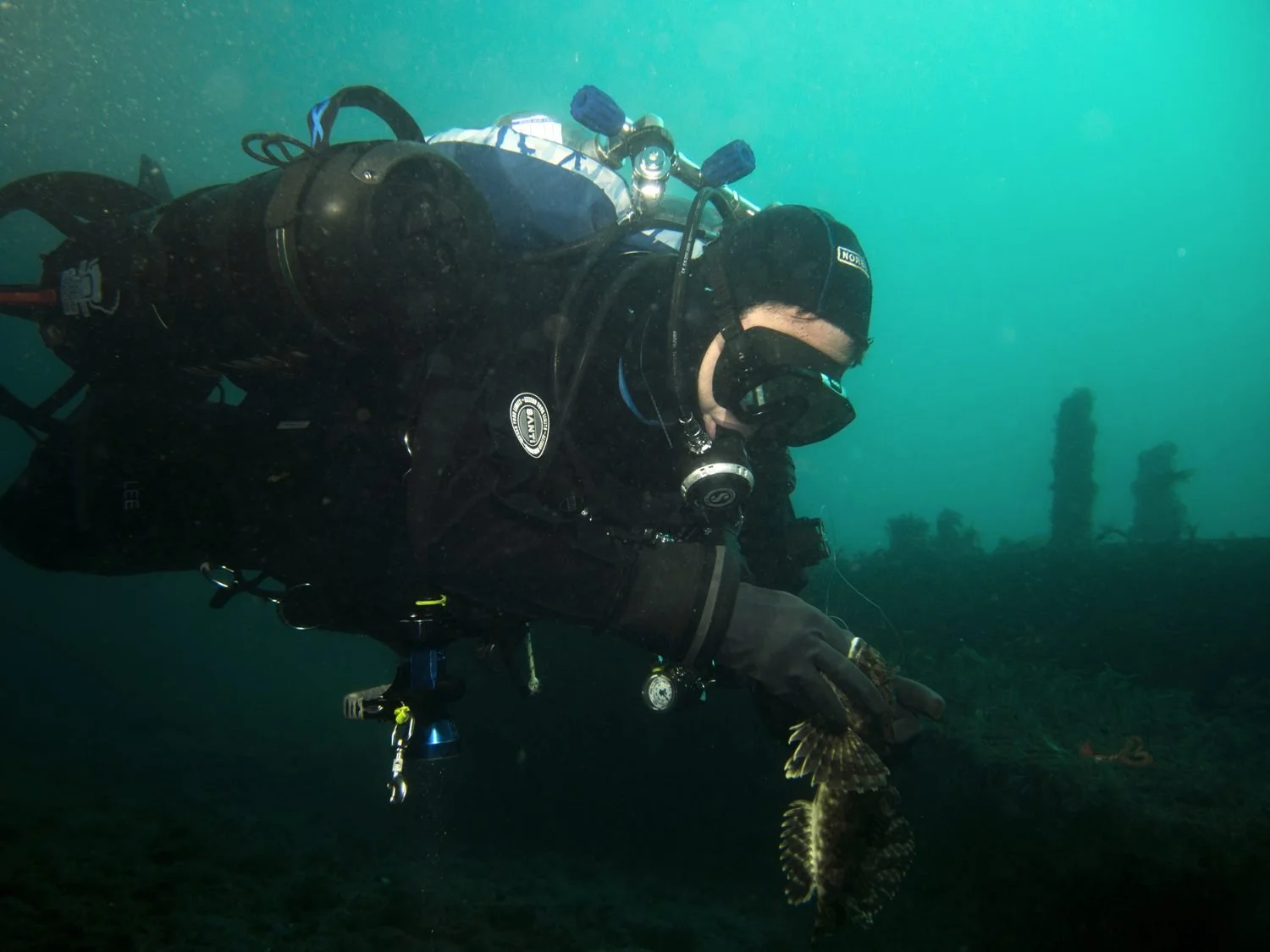
Location: Southern California
Wreck/Site: The African Queen (“Tammy”)
Boat: Giant Stride
Team: 6 divers, 2 surface support
Mission Impact: Survey dive. Ghost net and a lobster trap located and documented for future recovery; a hooked cabezon was freed.
Not every mission is a removal day. Team Ghost Diving USA set out aboard the Giant Stride for a survey of the African Queen, known to some of us as “Tammy,” as well as a few other local wrecks. Before we can plan a clean-up, we need eyes on the site — what gear is down there, how it sits, and what it will take to bring it up safely.
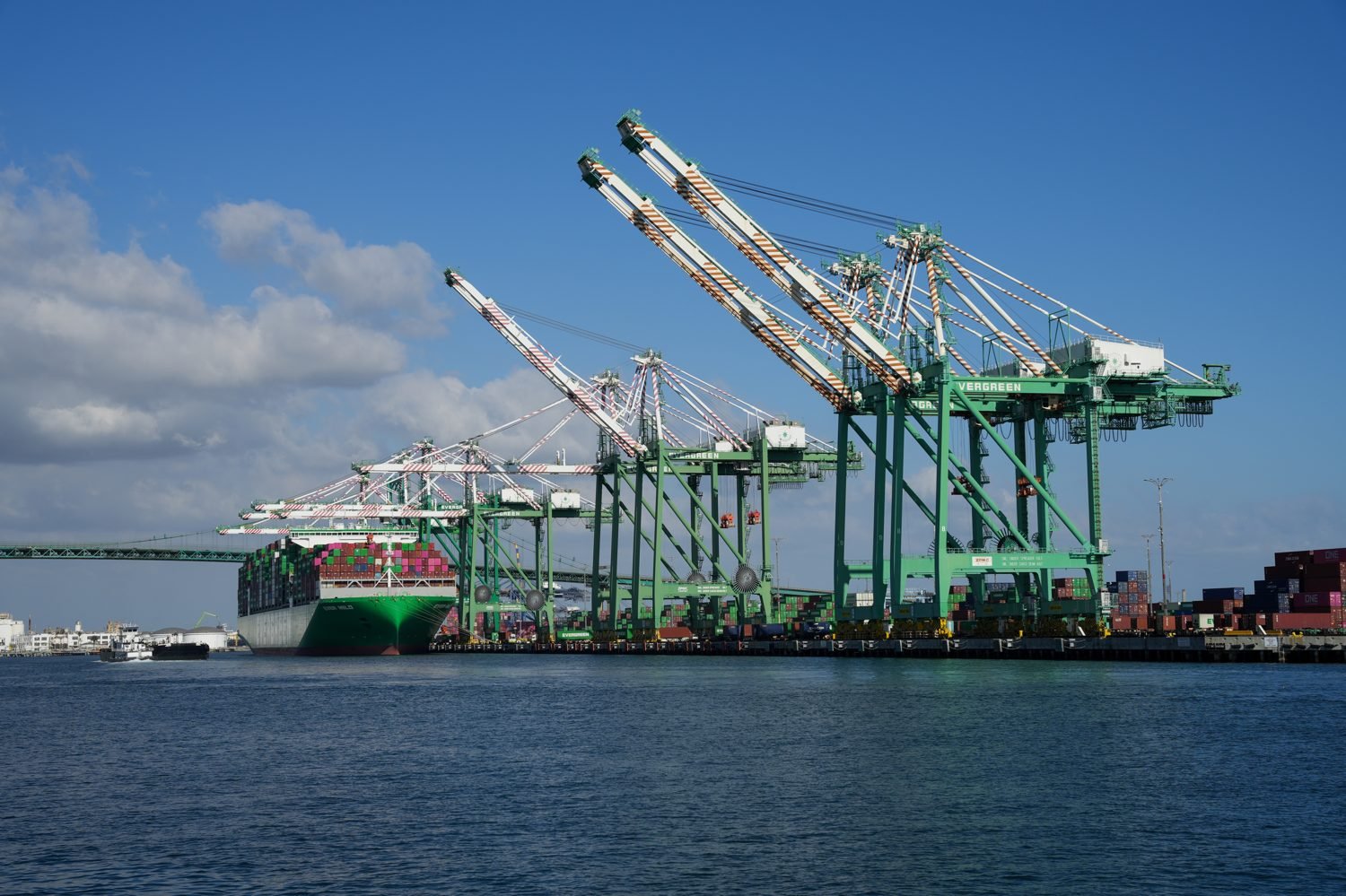
Heading out past the harbor cranes to start the day.
Over three dives at recreational depth, the team surveyed and documented the wreck. They found ghost net draped across the structure and photographed it from multiple angles to map out a future recovery.
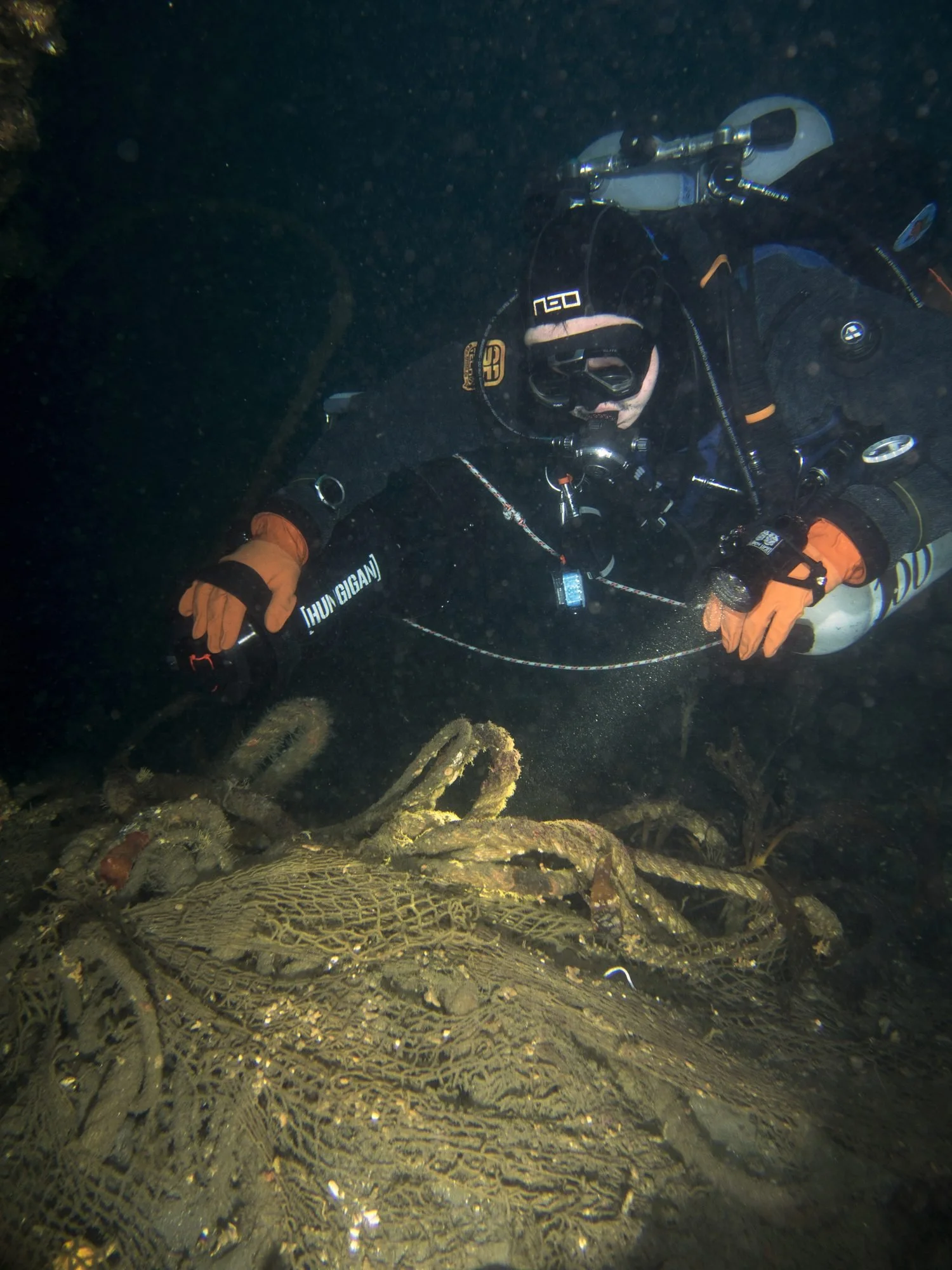
Documenting a section of ghost net on the African Queen.
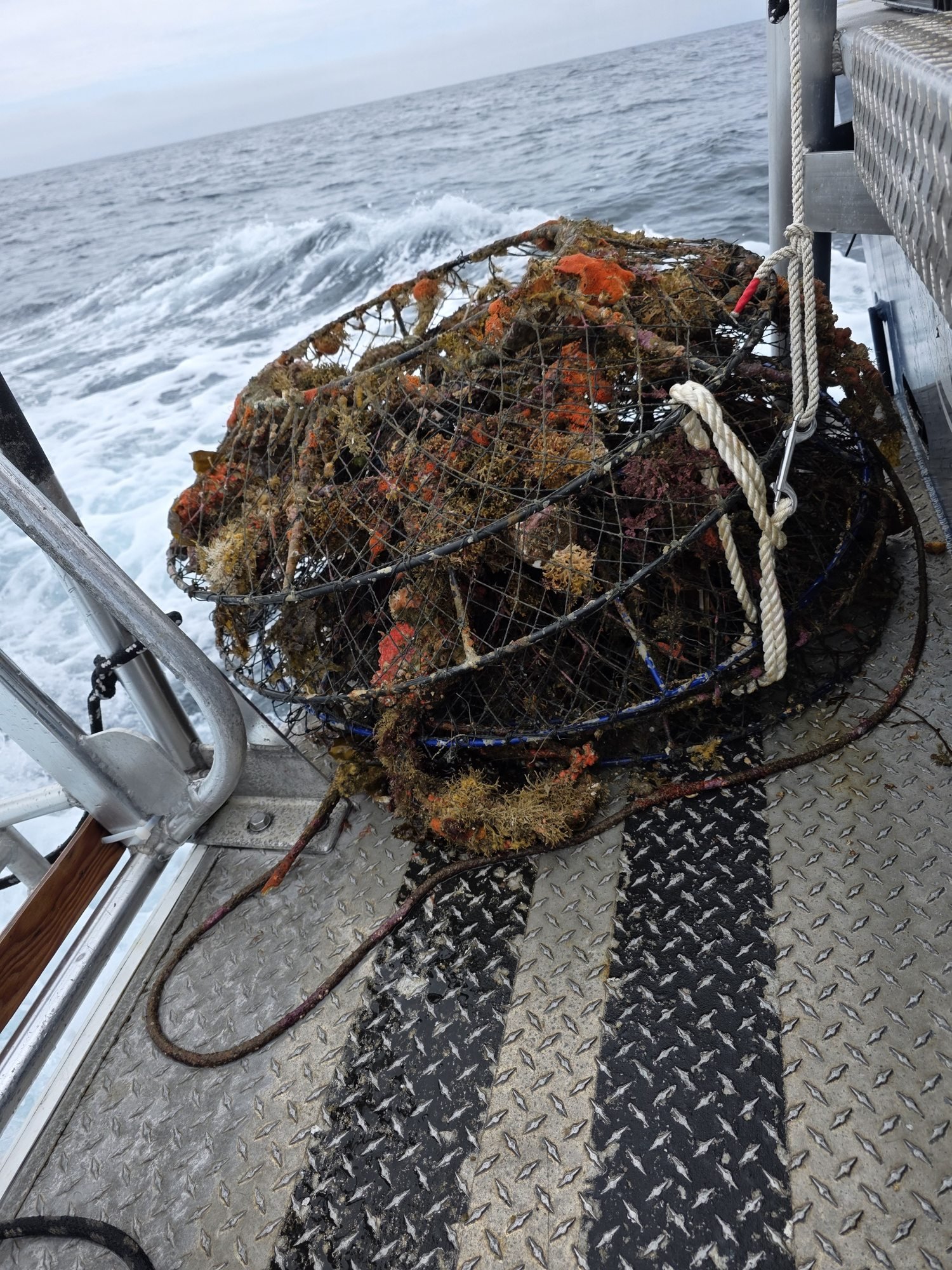
The team also located and documented multiple lobster traps on the site, recording there position and condition so it can be addressed on a return trip.
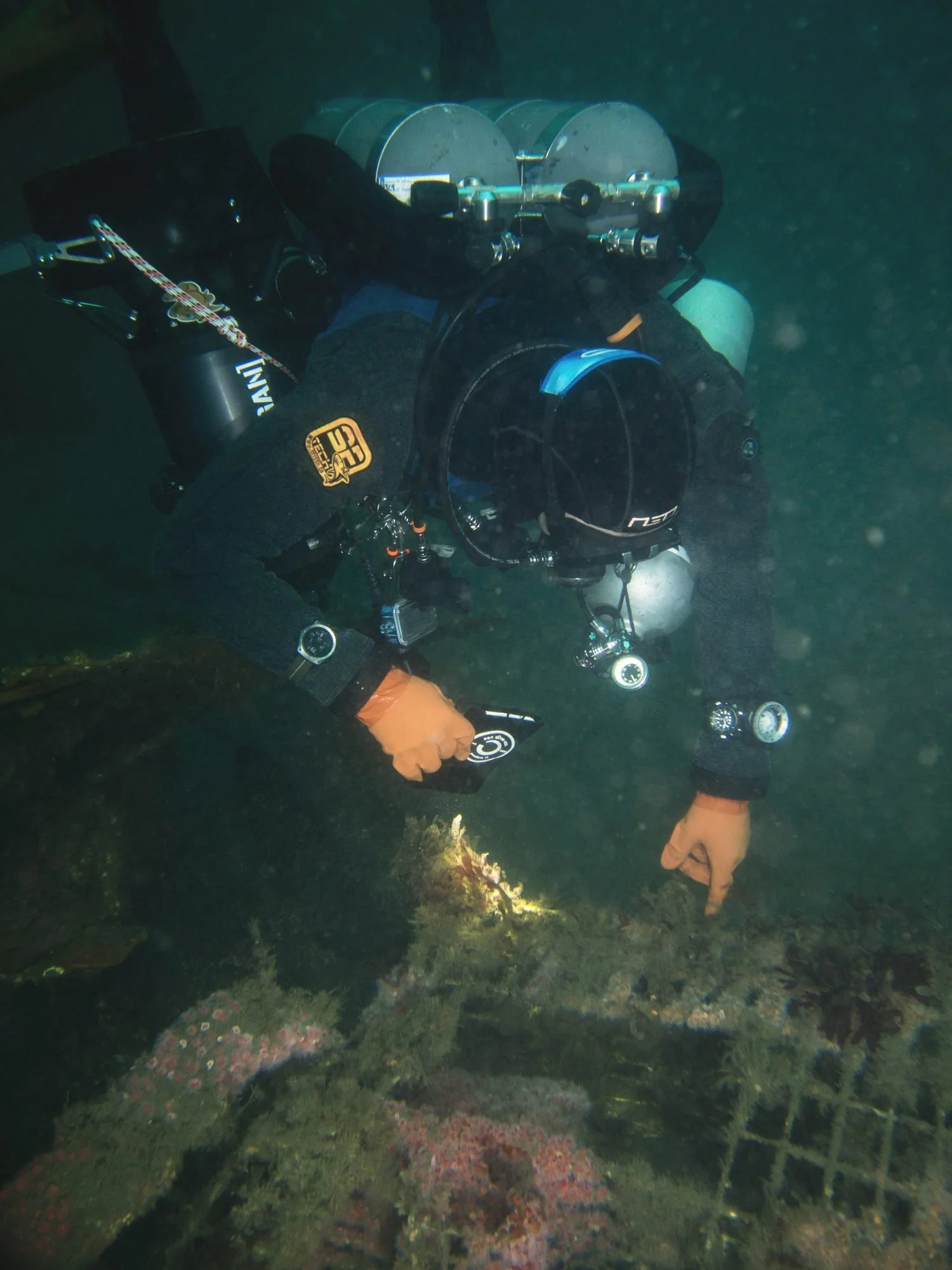
Survey dives are also a reminder of exactly what is at stake. As the team worked, they came across a cabezon that had been hooked and freed it — a small but meaningful save, and a reminder of why this gear cannot be left where it lies.
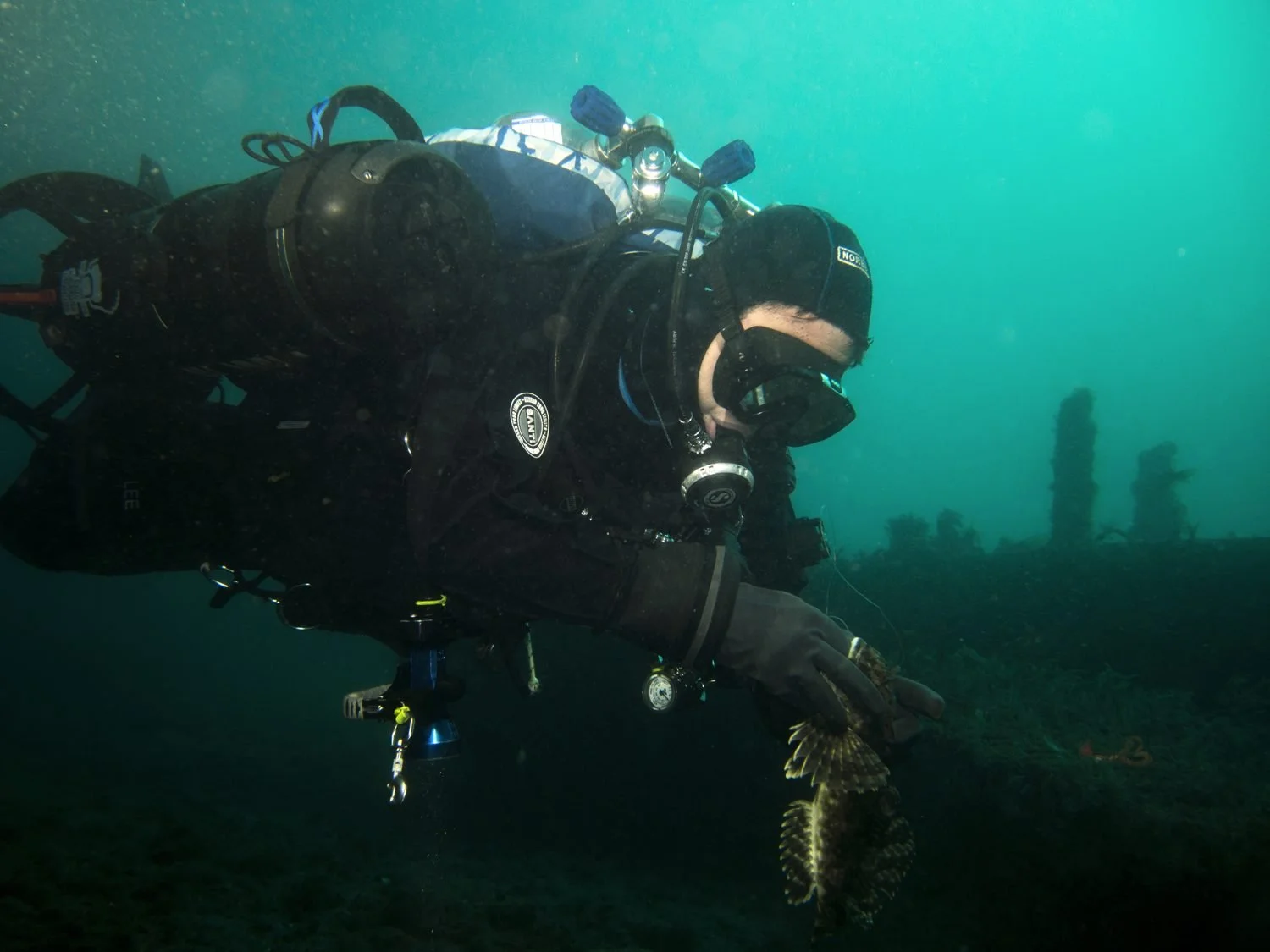
Norbert Lee frees a hooked cabezon during the survey.
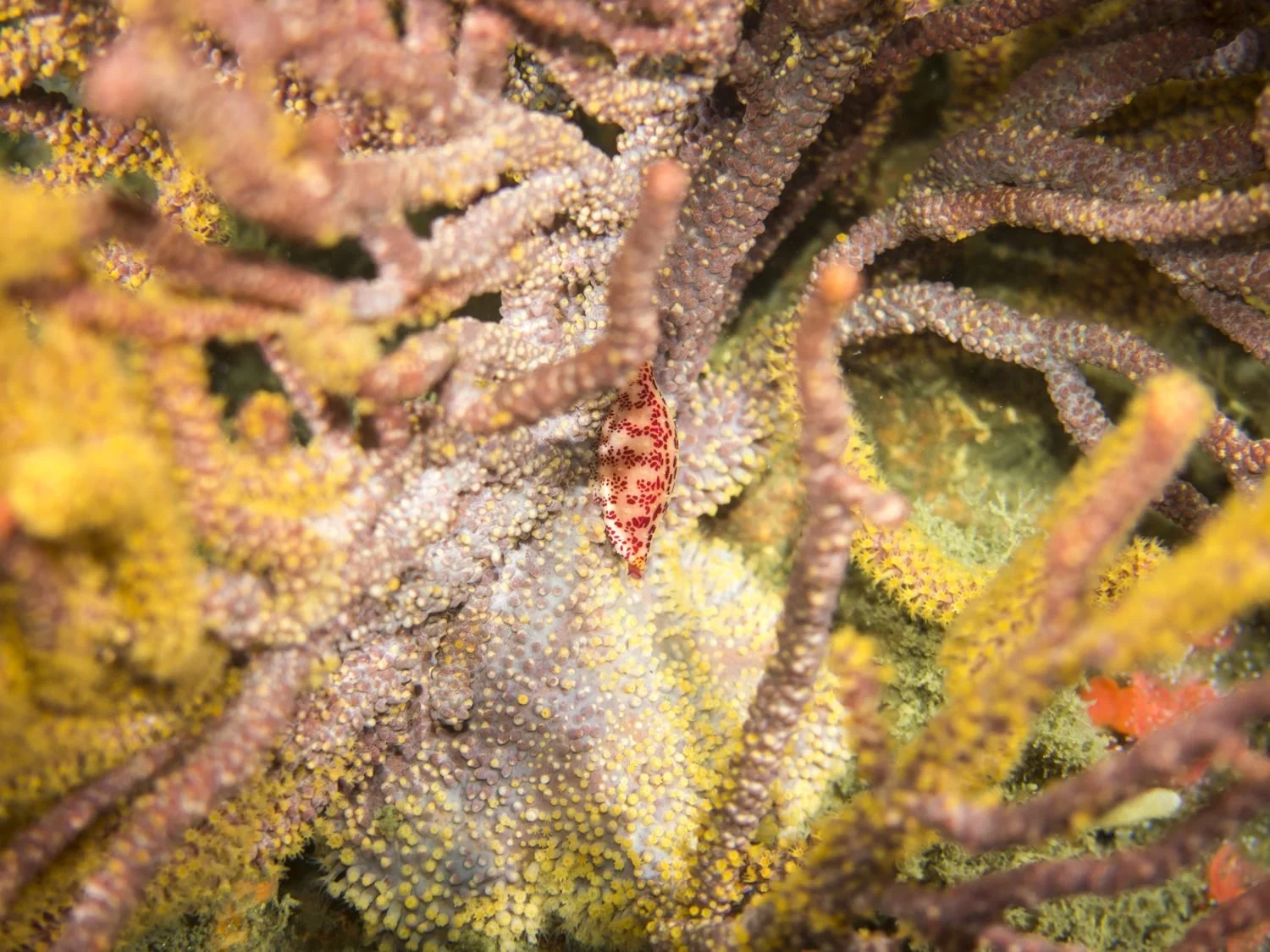
For all the damage ghost gear does, these wrecks are also bursting with life. Among the survey shots was this tiny ovulid snail (simnia barbarensis) tucked into a gorgonian — exactly the kind of habitat we are working to protect.
With the African Queen surveyed and documented, the groundwork is set. We know what is down there and what it will take — and we will be back to remove it.
A very special thank you to Captain Jim and the crew of the Giant Stride, and to our partners for supporting our work.
Arrow Point
Location: Southern California — Arrow Point, Catalina Island
Site: Arrow Point
Boat: Giant Stride
Team: 3 divers, 1 surface support
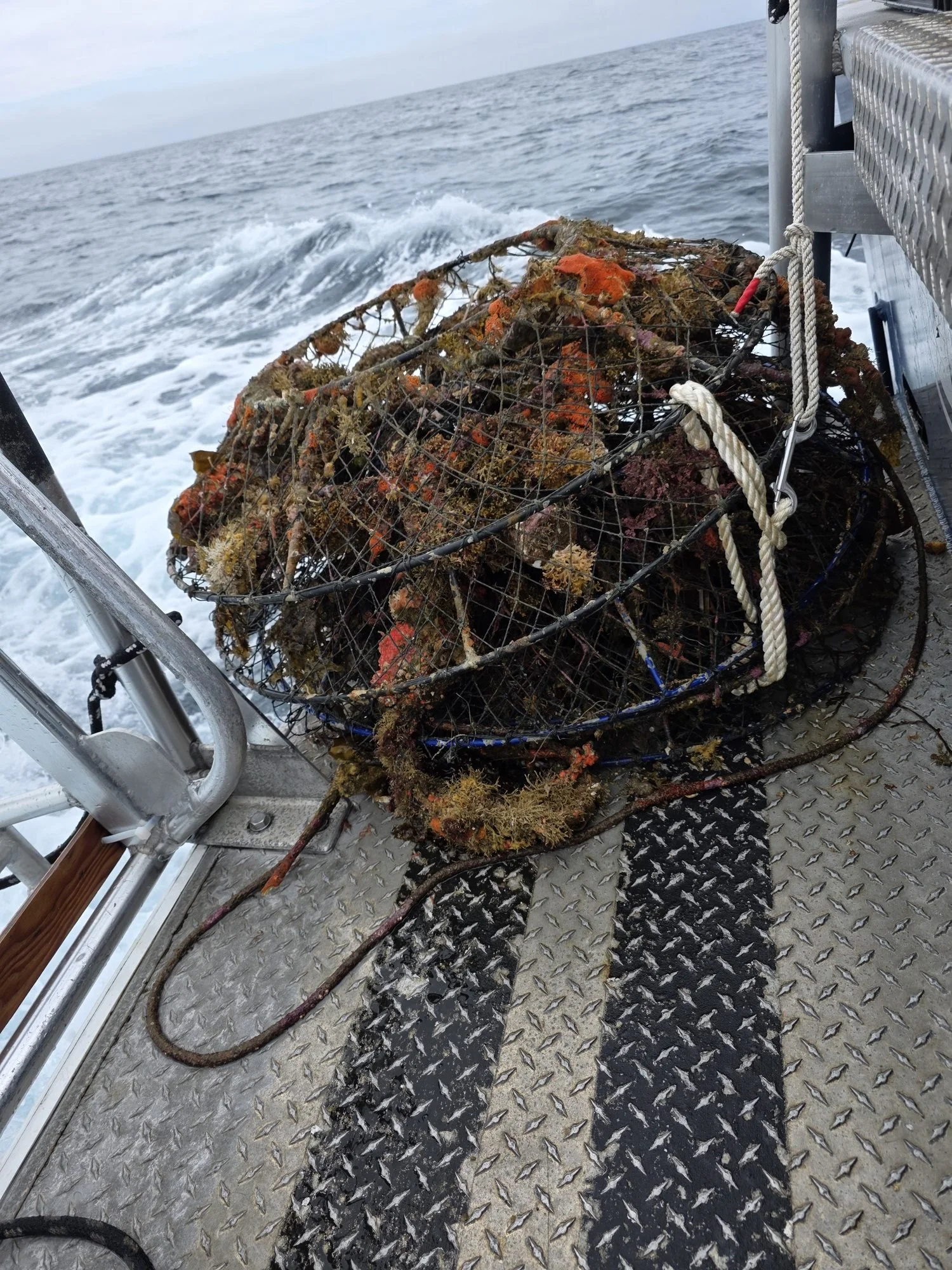
Not all of the ghost gear off our coast are nets. Lost and abandoned lobster traps keep "ghost fishing" too, catching and killing lobster, fish, and other marine life continuously with no one ever coming to pull them up. With the lobster season opener approaching, Team Ghost Diving USA set out aboard the Giant Stride for Arrow Point, off Catalina Island, with a clear goal: clear the remaining lost traps from the site before they could trap another season's worth of marine life.
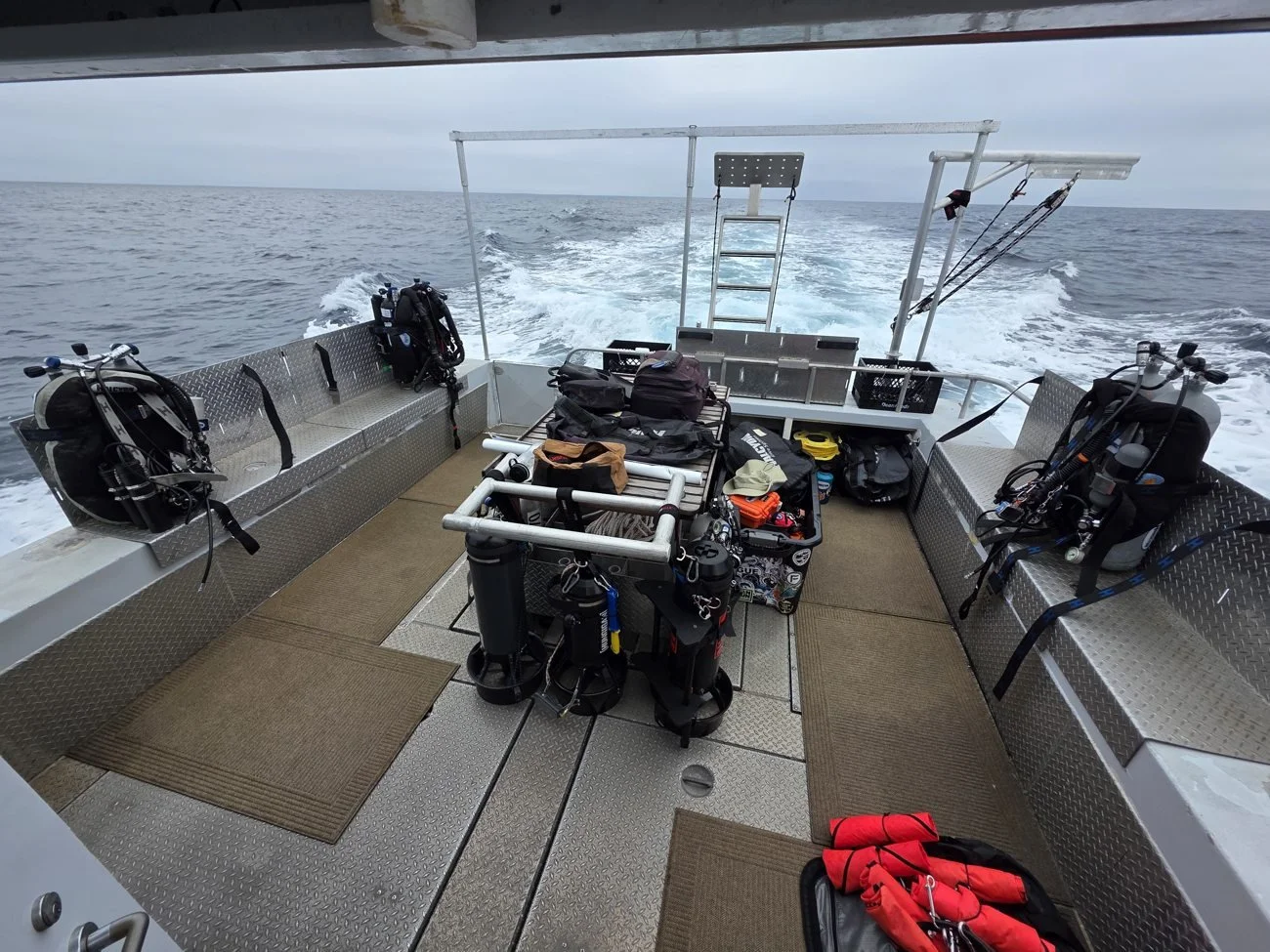
Gear staged and ready on the deck of the Giant Stride on the run out to Arrow Point.
Arrow Point is a deep technical site, and the traps tend to sit well down the slope, so the dive called for careful gas planning and staged decompression. After a thorough briefing, the team dropped in, located the lost traps, and rigged each one to be lifted off the bottom and brought up to the boat.
By the end of the day the team had cleared out the lost pots we had been tracking at the site. With these removed ahead of the season opener, no abandoned traps remain at Arrow Point to keep ghost fishing.
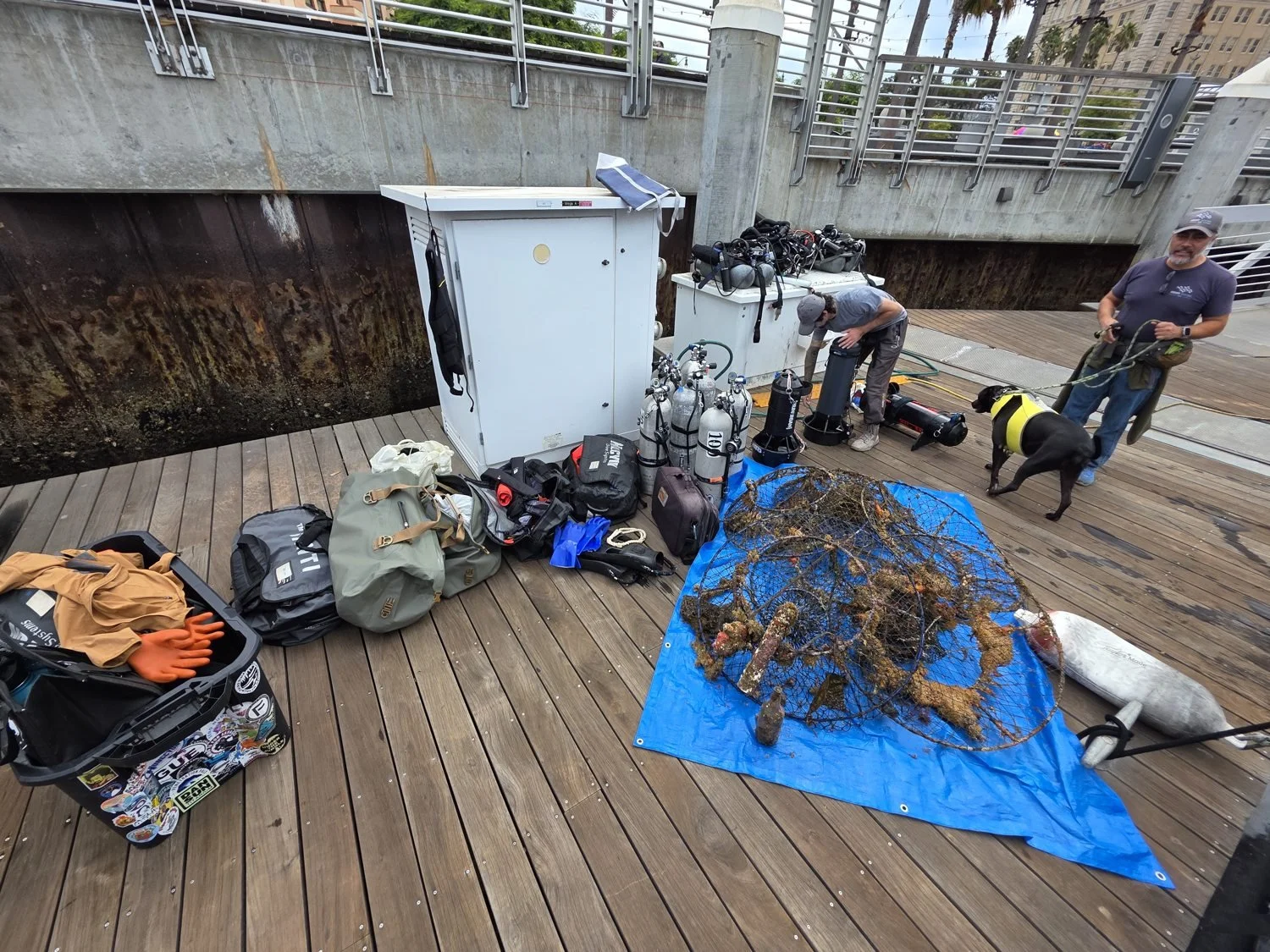
A great result for the team and another meaningful dent in the ghost gear off our coast. These traps will no longer catch and kill marine life on the reef at Arrow Point. We will return next year after lobster season concludes.
A very special thank you to Captain Jim and the crew of the Giant Stride for supporting our clean-up efforts.
White Point
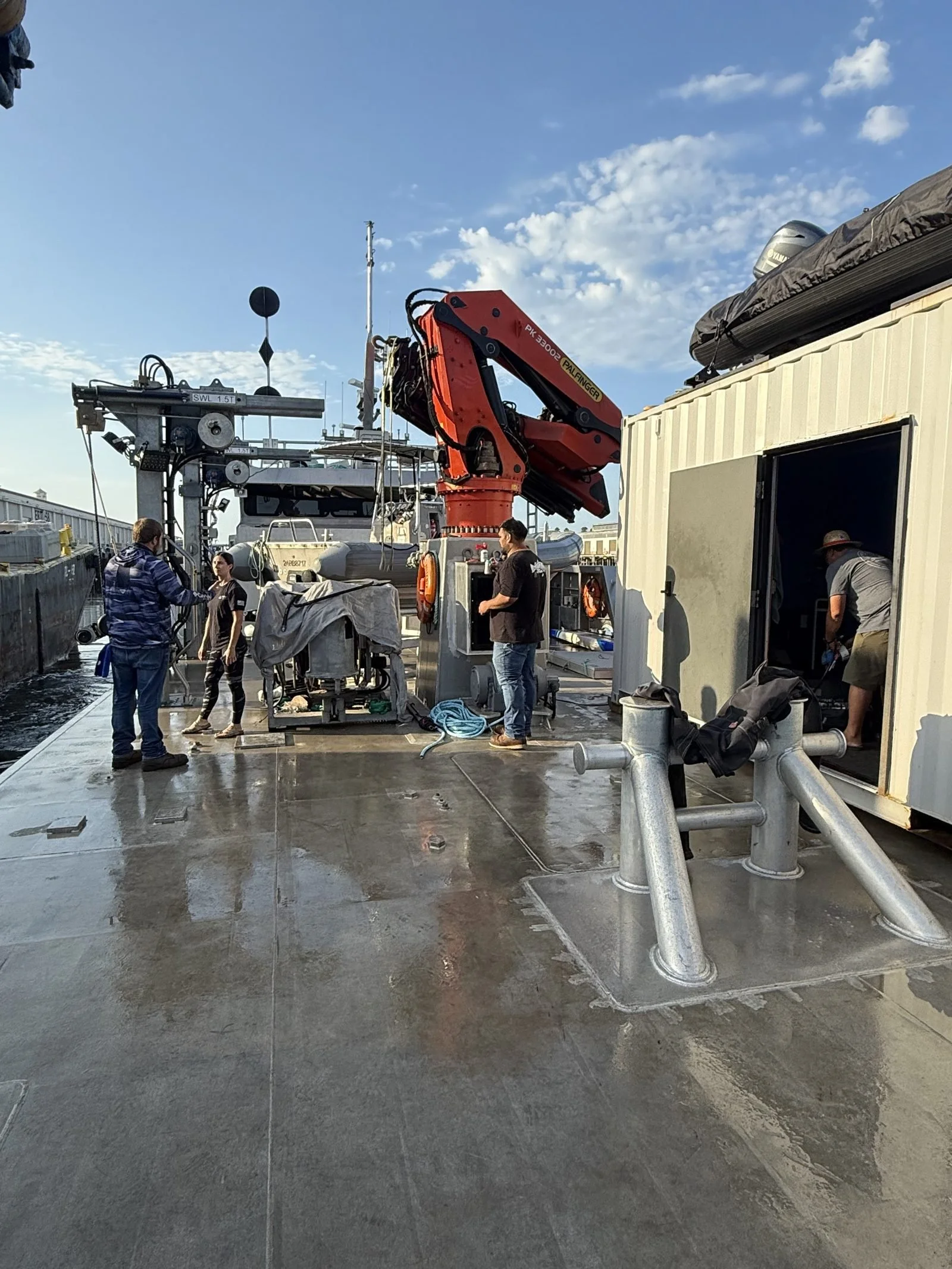
A new boat for us: the Pacific Alliance, with its hydraulic crane and working deck, ready to take on bigger missions.
Location: Southern California
Site: White Point
Boat: Pacific Alliance
Depth: Technical — roughly 185 to 200 feet
Divers: Jim Babor, Karim Hamza, Norbert Lee, Mike Gasbarro, Mark Self, Jung Hsieh
Surface Support: Angie Biggs,
Mission Impact: 300 pounds of net removed (approximately 600 square feet) and delivered to Aquafil for recycling.
This mission was a milestone for us in more ways than one. For the first time, Team Ghost Diving USA worked from the Pacific Alliance, a larger vessel that is new to us and a real step up in capability. With a spacious working deck and a hydraulic crane for handling heavy gear, the Pacific Alliance opens the door to bigger and more ambitious missions than we have been able to take on before. This day was our trial run, and we came with a clear objective: recover a section of net at the White Point that had previously been located and filmed by an ROV in roughly 180 feet of water.
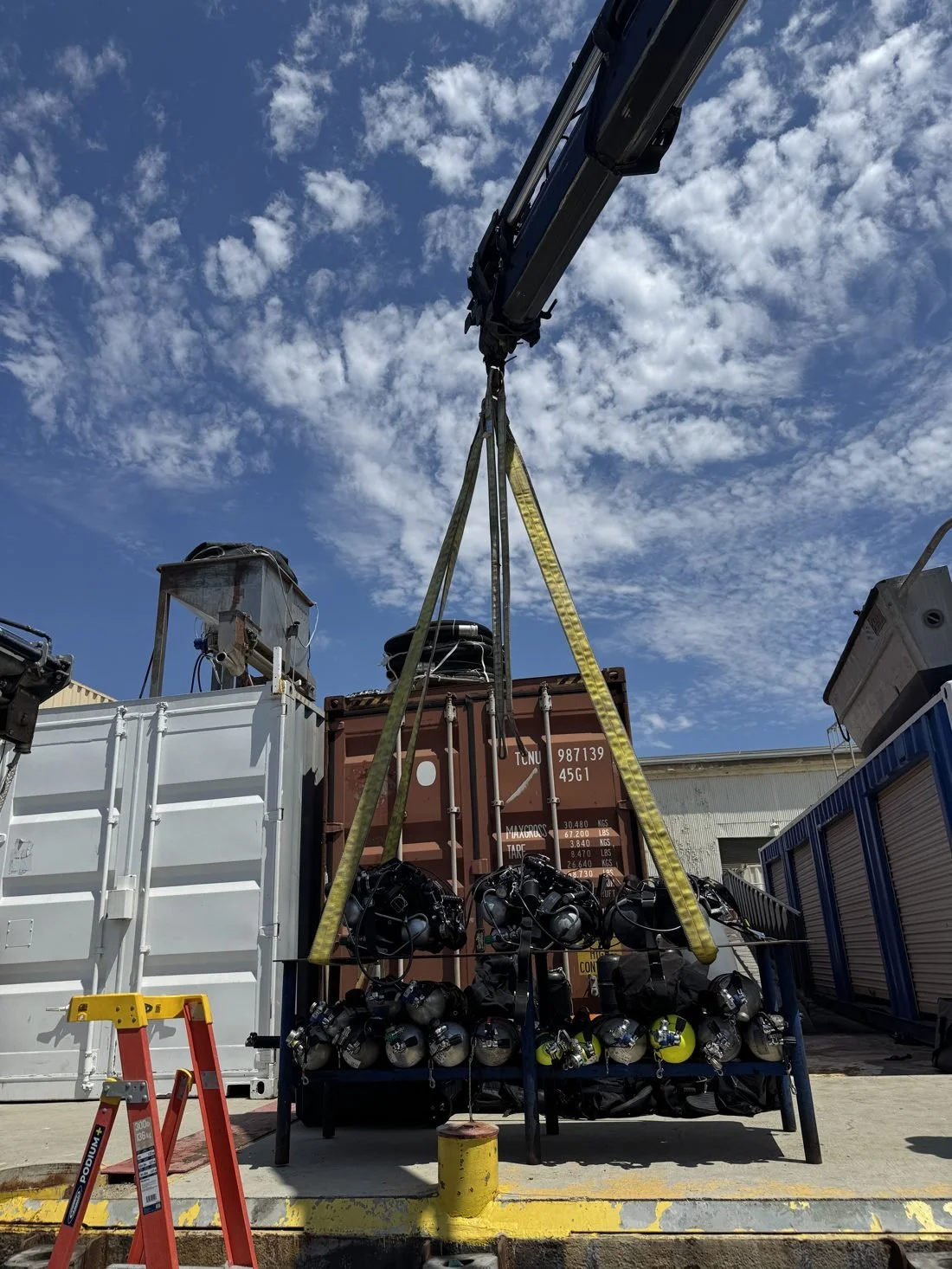
The crane makes light work of heavy loads, here a full rack of cylinders and rebreathers swung aboard.
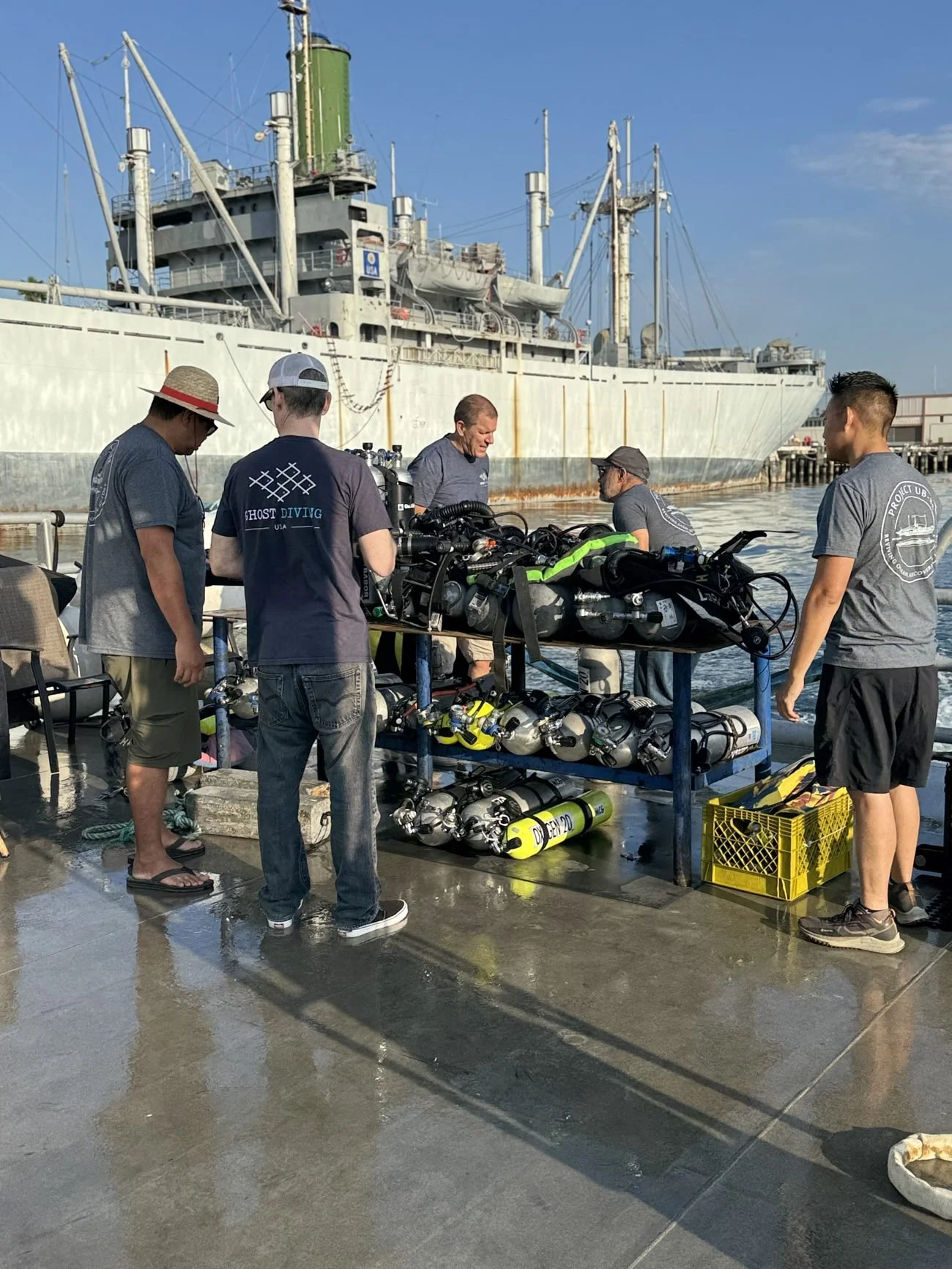
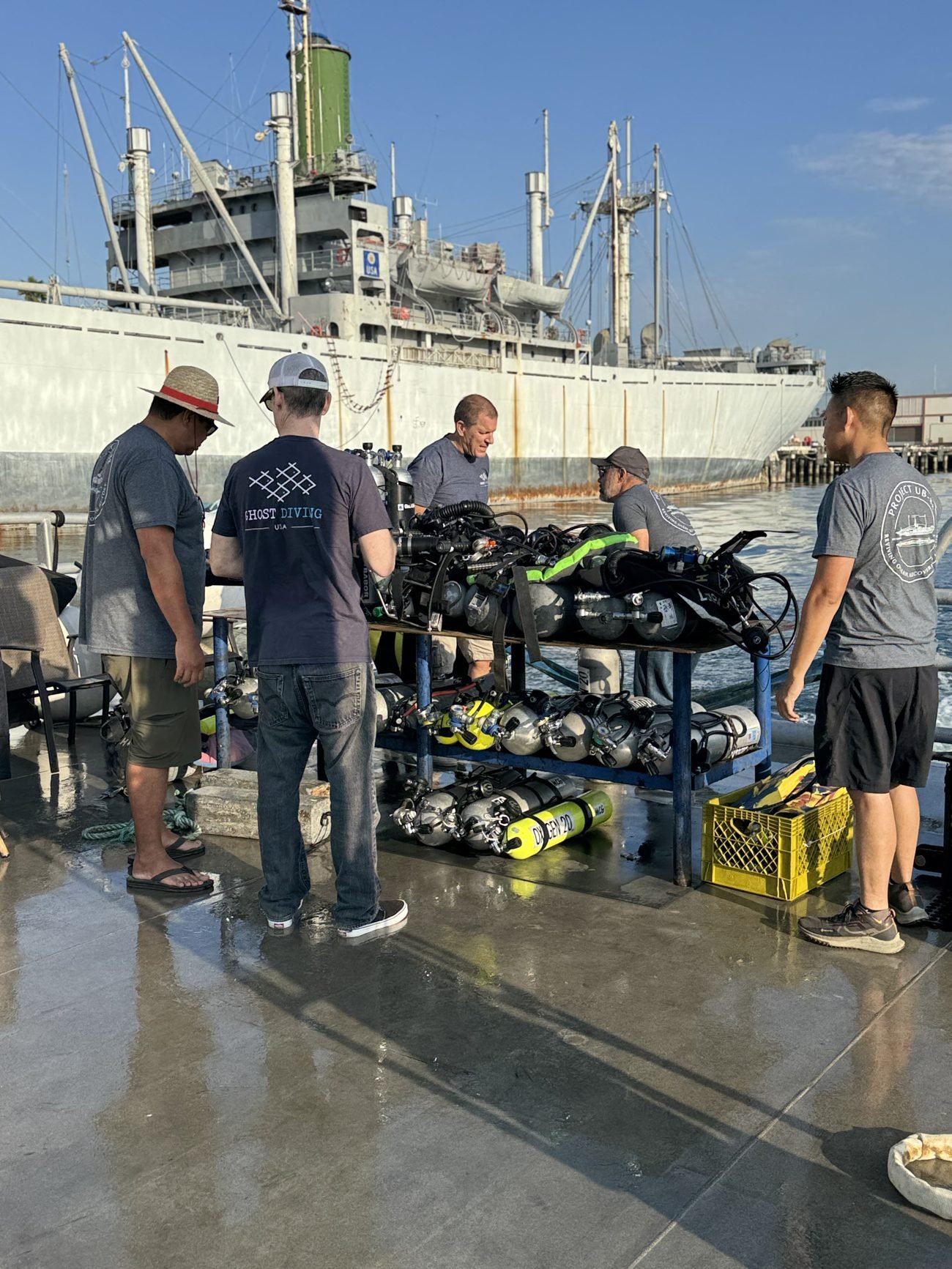
Building and checking gear on the dock before departure.
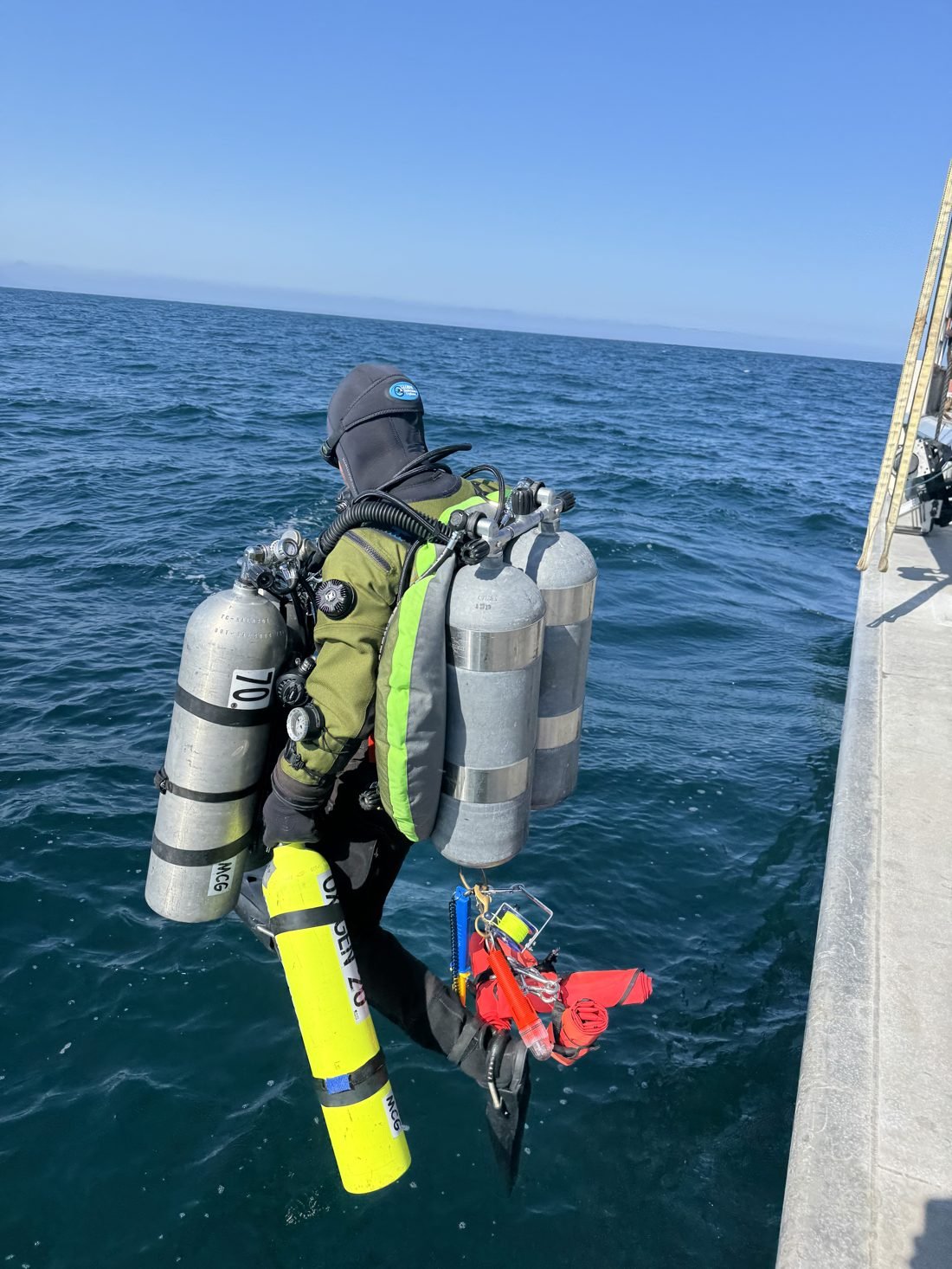
On the bottom, the divers located the net and went to work, placing lift bags, cutting it free, and inflating the bags to carry it toward the surface. As always, our divers checked the net carefully for entangled marine life as they cut. The teams worked in pairs on either side of the net, meeting in the middle, then surfaced and signaled all-clear to the boat.
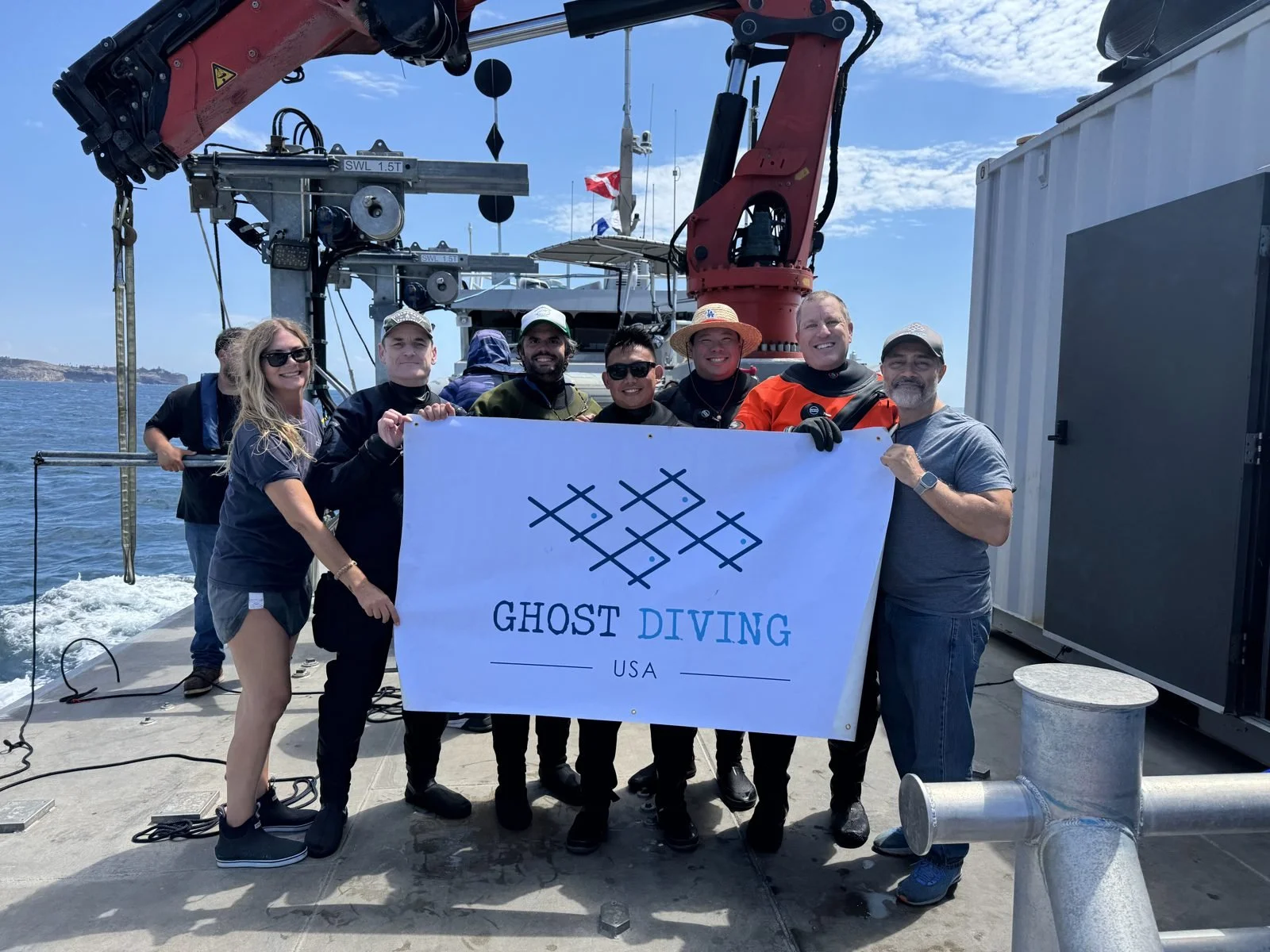
The team aboard the Pacific Alliance after a successful trial run at White Point.
When the net was tallied, the team had removed roughly 300 pounds, about 600 square feet, of ghost net from the site. That is 300 pounds of net that can no longer entangle and kill marine life. The recovered net was delivered to Aquafil to be recycled and given a second life rather than left to fish forever on the bottom.
A very special thank you to the captain and crew of the Pacific Alliance, and to our partners at Healthy Seas, and Aquafil for supporting our clean-up efforts.
Los Angeles Yacht Club
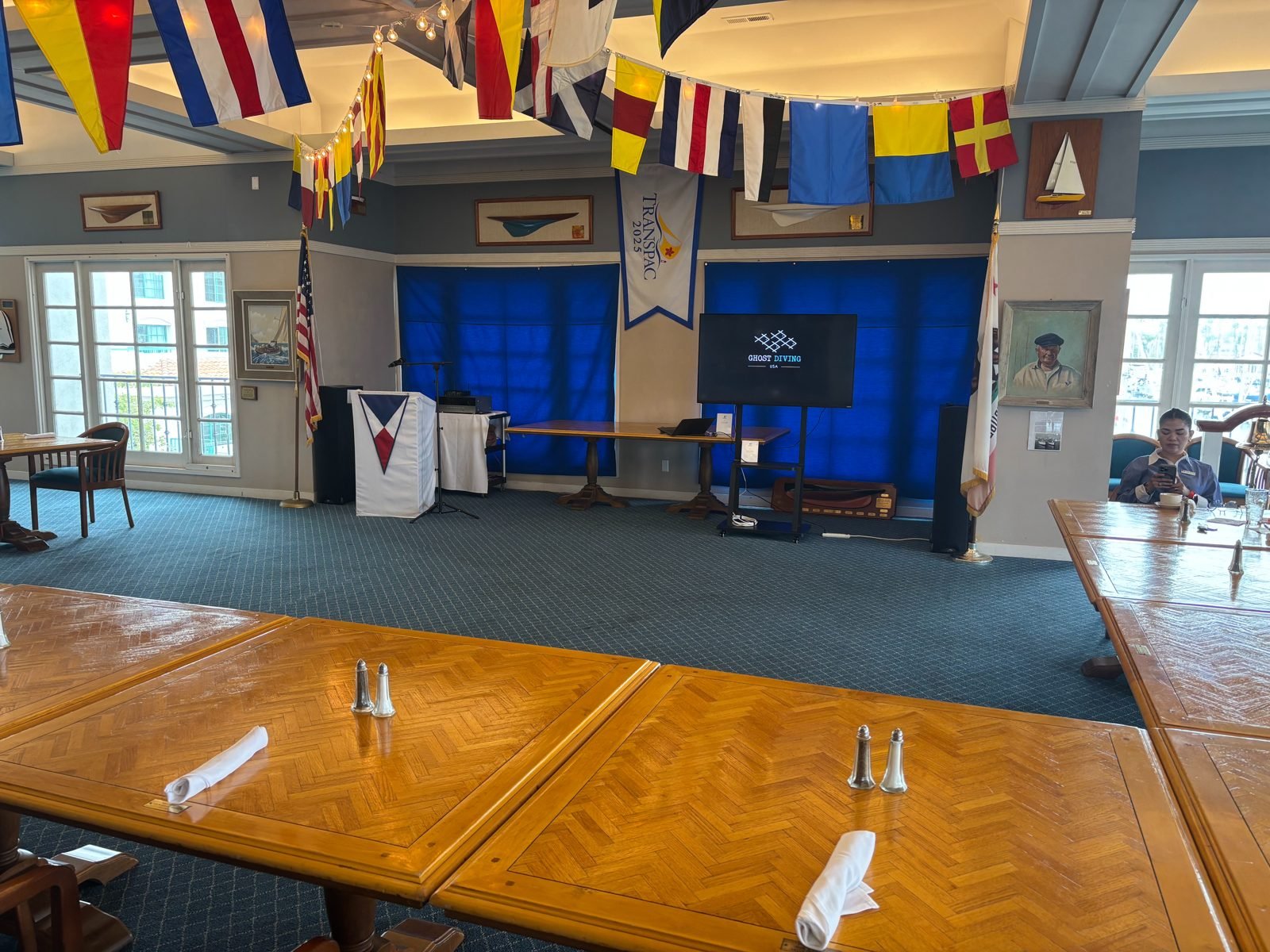
Event: Outreach Presentation
Host: Los Angeles Yacht Club, San Pedro
Presenter: Jim Babor, President of Ghost Diving USA
Not every mission happens underwater. On August 13th, Team Ghost Diving USA was welcomed to the Los Angeles Yacht Club in San Pedro, where President Jim Babor gave a presentation to the club's members about the work we do off the Southern California coast.
Jim opened with an overview of who we are and the problem we exist to fight: the lost and abandoned fishing gear, "ghost nets" and traps, that keeps entangling and killing marine life on the wrecks and reefs off our coast long after it was lost. For a room full of people who spend their lives on the water, it is a problem that hits close to home.
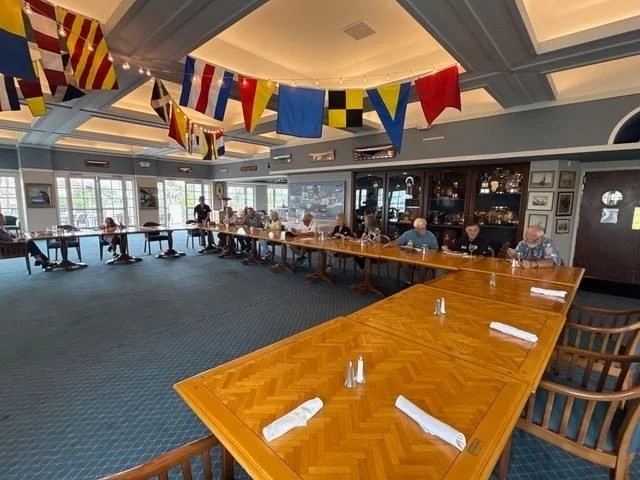
From there, Jim walked the club through some of our recent cleanups, the ongoing work on the Tuna Clipper, the major recovery effort on the UB-88, and the other sites our dive teams have been steadily clearing. He shared what the dives actually involve: careful gas planning, staged decompression, divers cutting net free by hand and lifting it to the surface, and a dedicated documentation and surface support crew on every mission.
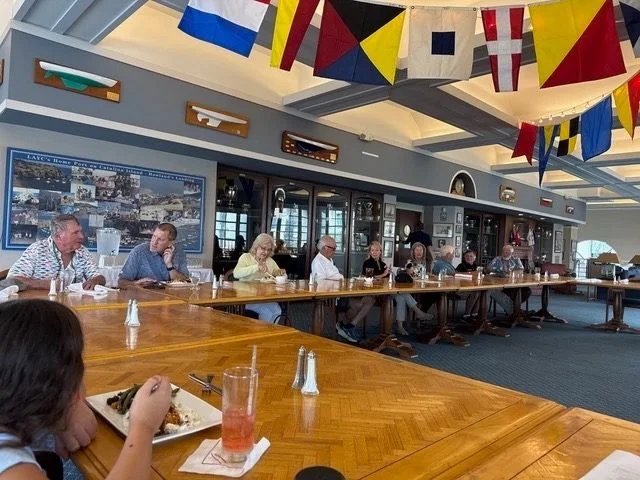
Just as important is what happens to the net after it comes up. Jim explained the full side of the work: recovered nylon net is delivered to Aquafil, where it is recycled into ECONYL® regenerated nylon and given a second life rather than left to fish forever on the bottom. None of this happens alone, our cleanups are made possible by partners like Healthy Seas.
Jim closed with an invitation: there are many ways for a community like the Los Angeles Yacht Club to get involved, volunteering, donating, or partnering with us to keep these missions going. Conversations like this one are how the work grows, and we were grateful for such an engaged and welcoming audience.
A very special thank you to the Los Angeles Yacht Club and its members for hosting us and for their interest in protecting the waters we all share.
Tuna Clipper
Location: Southern California
Site: Tuna Clipper
Boat: Giant Stride
Divers: Jim Babor, Curtis Wolfslau, Symeon Maniaskas, Andrew Hung, Erik Lu
Surface Support: Laurie Dickson, Karim Hamza
Mission Impact: 100 pounds of net removed (approximately 300 square feet) and delivered to Aquafil for recycling.
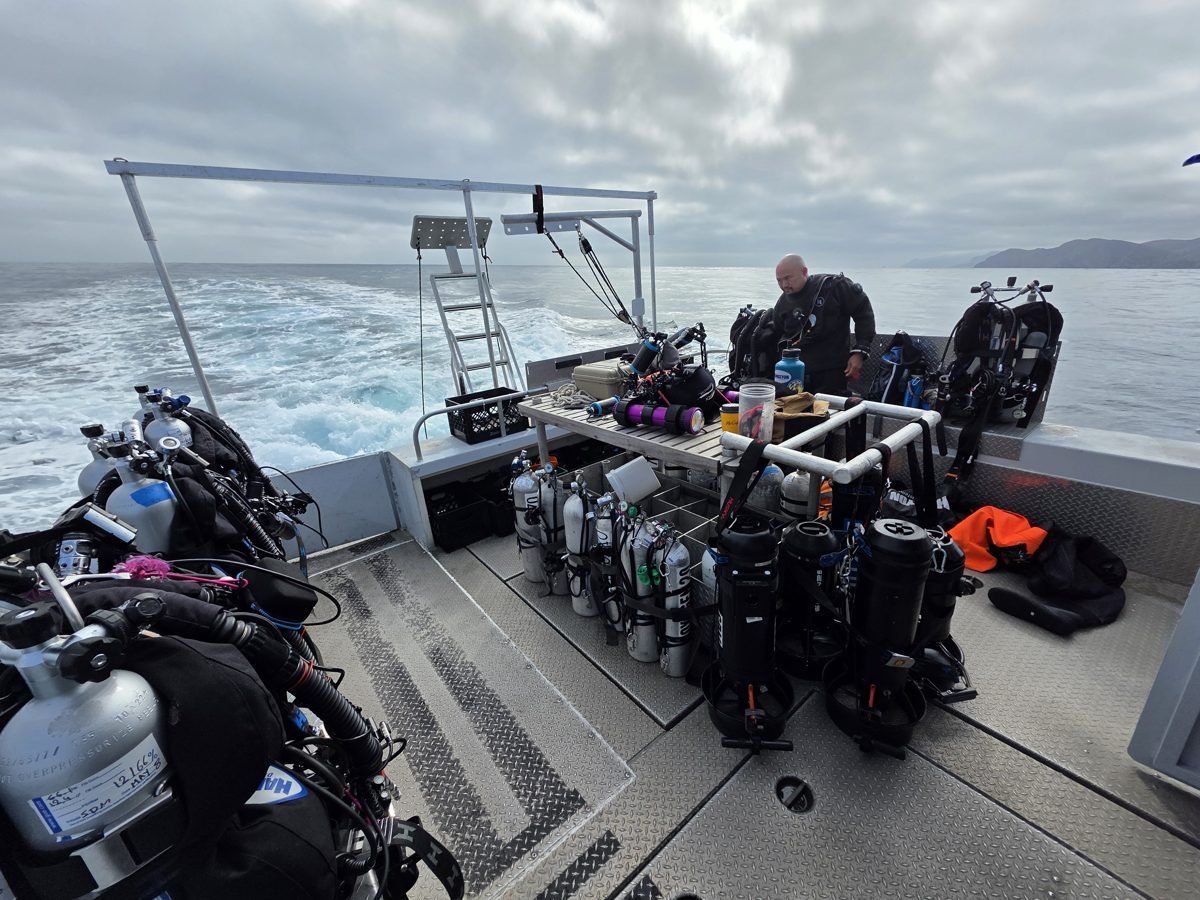
Team Ghost Diving USA set out aboard the Giant Stride for the Tuna Clipper, one of our regular sites off the coast and a wreck that keeps collecting lost net. The Tuna Clipper sits in technical diving territory, so the day began the way these missions always do: gas planned, deco bottles staged, scooters, and a clear plan for what we wanted to bring up.
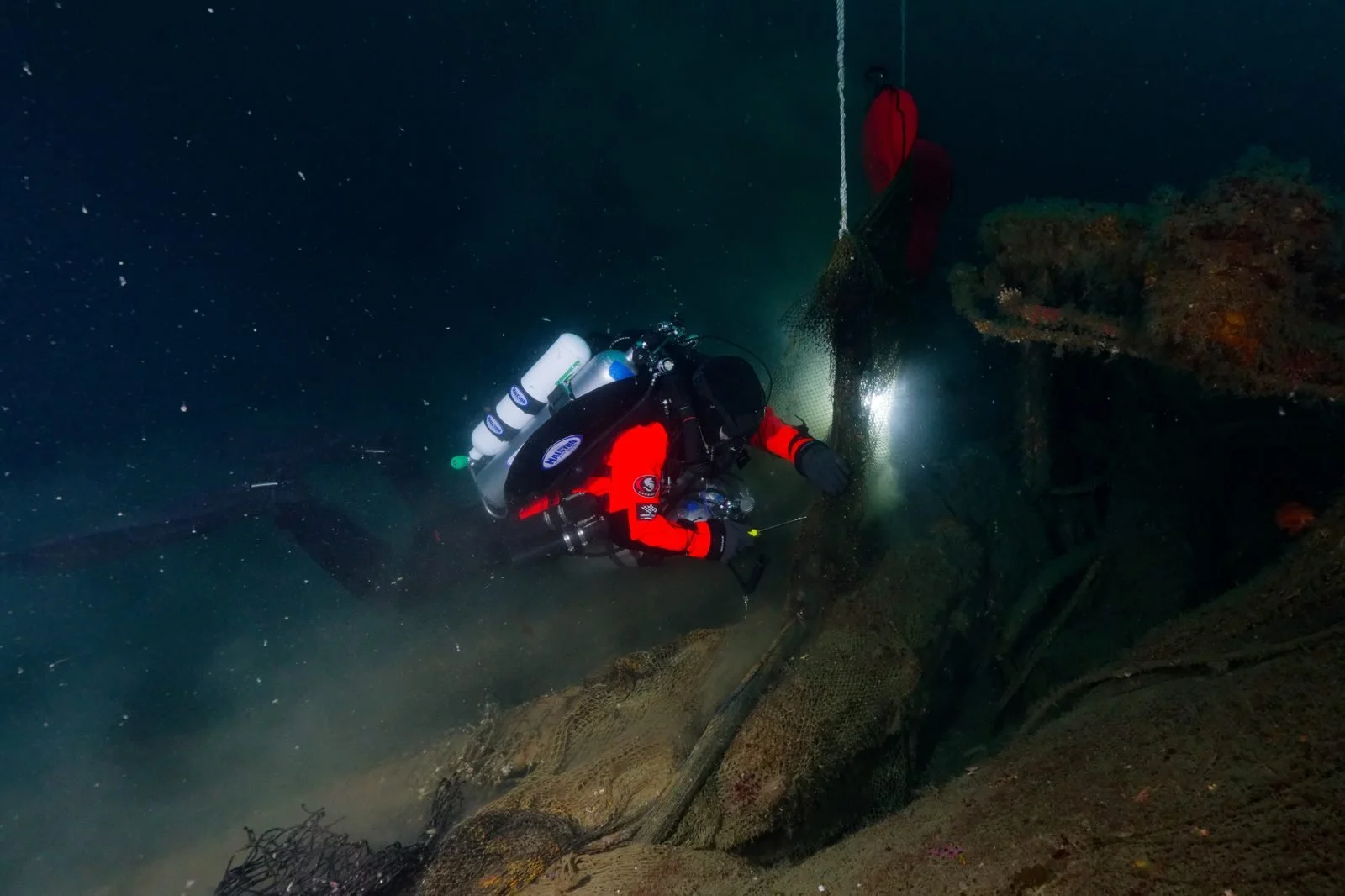
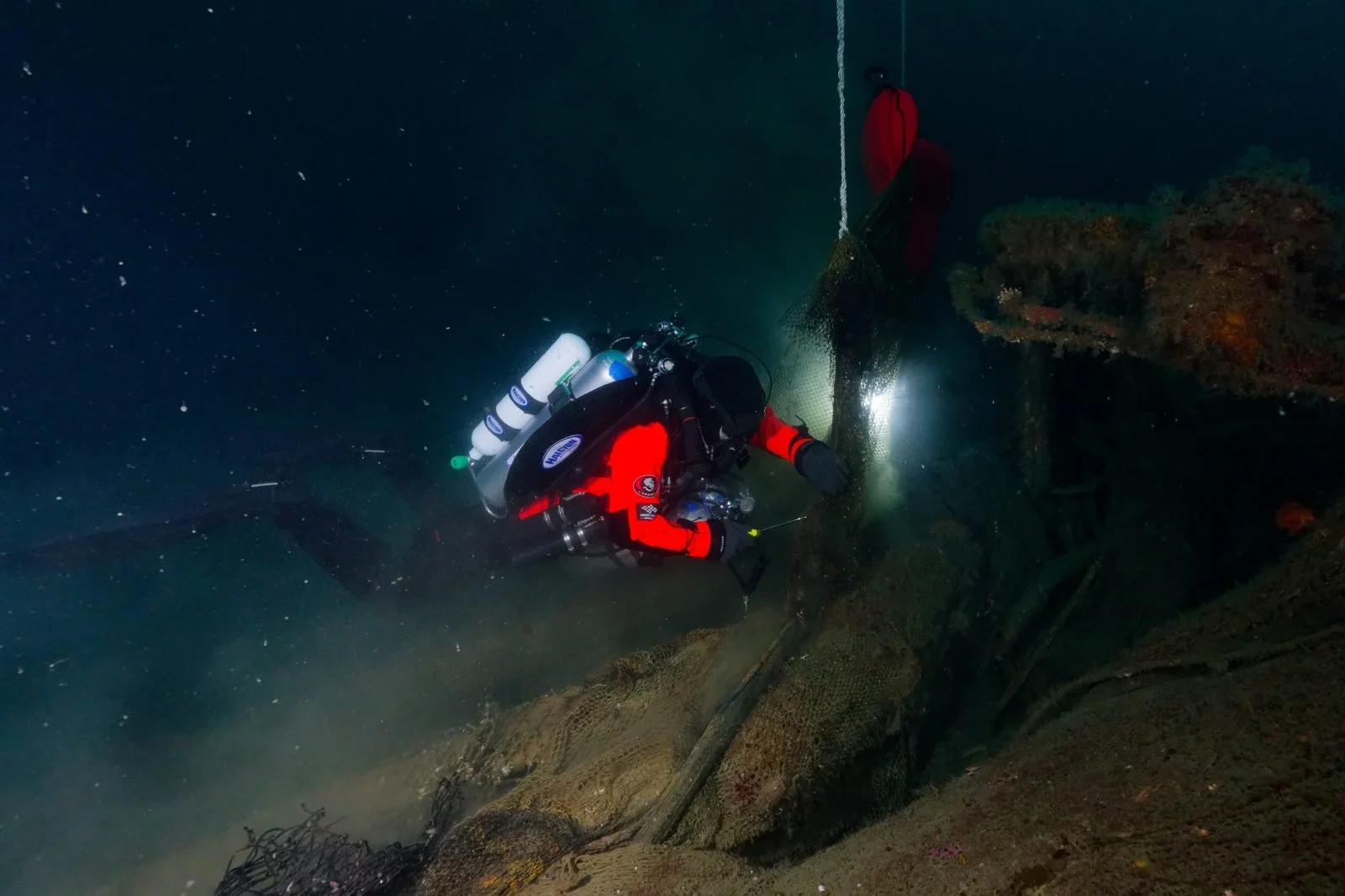
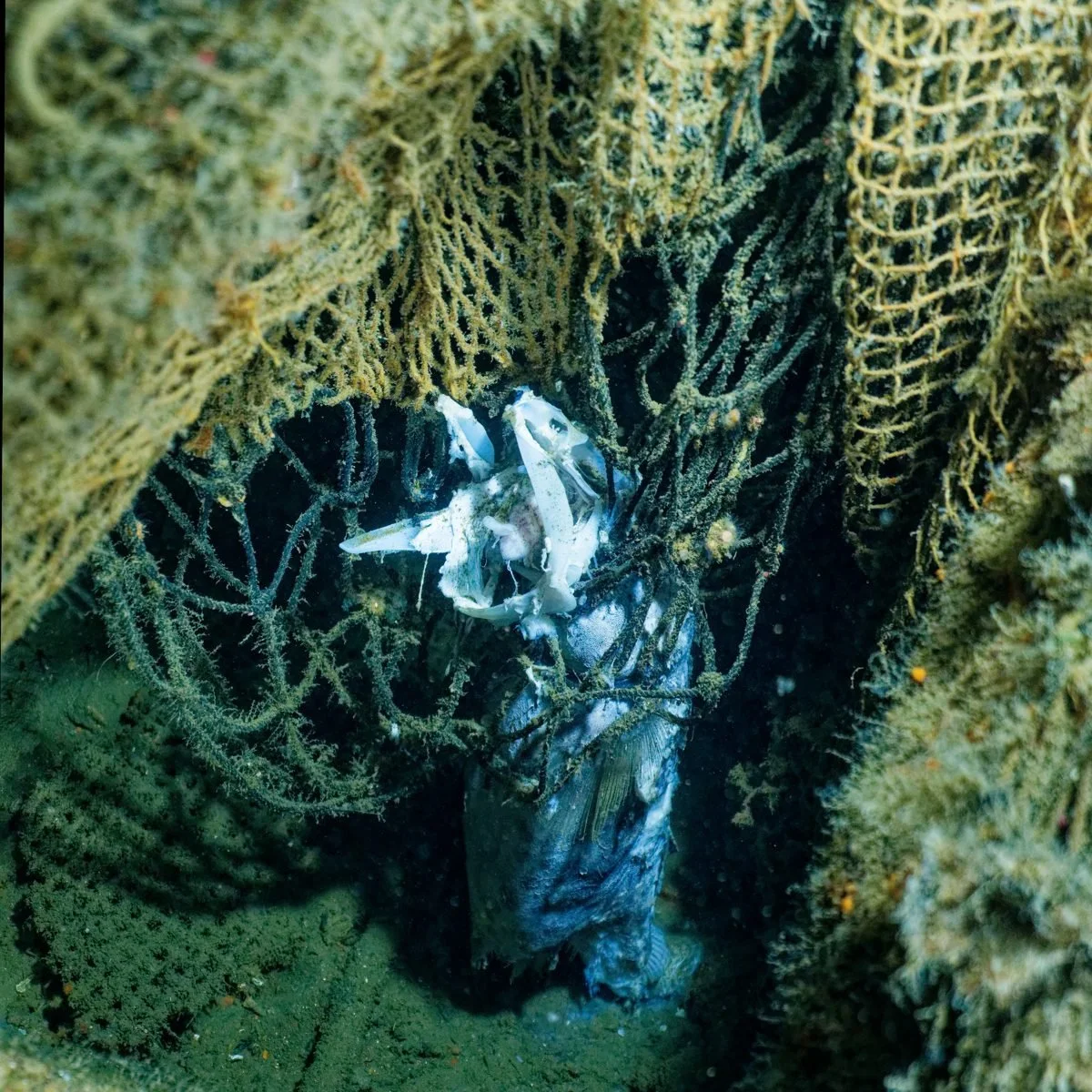
The Tuna Clipper continues to be draped in lost and abandoned fishing net. Since the site is covered we consistently find deceased marine wildlife including this fish we encountered below:
On the bottom, the divers located the section of net they had come for and went to work placing lift bags, cutting the net free, and inflating the bags to carry it up toward the surface.
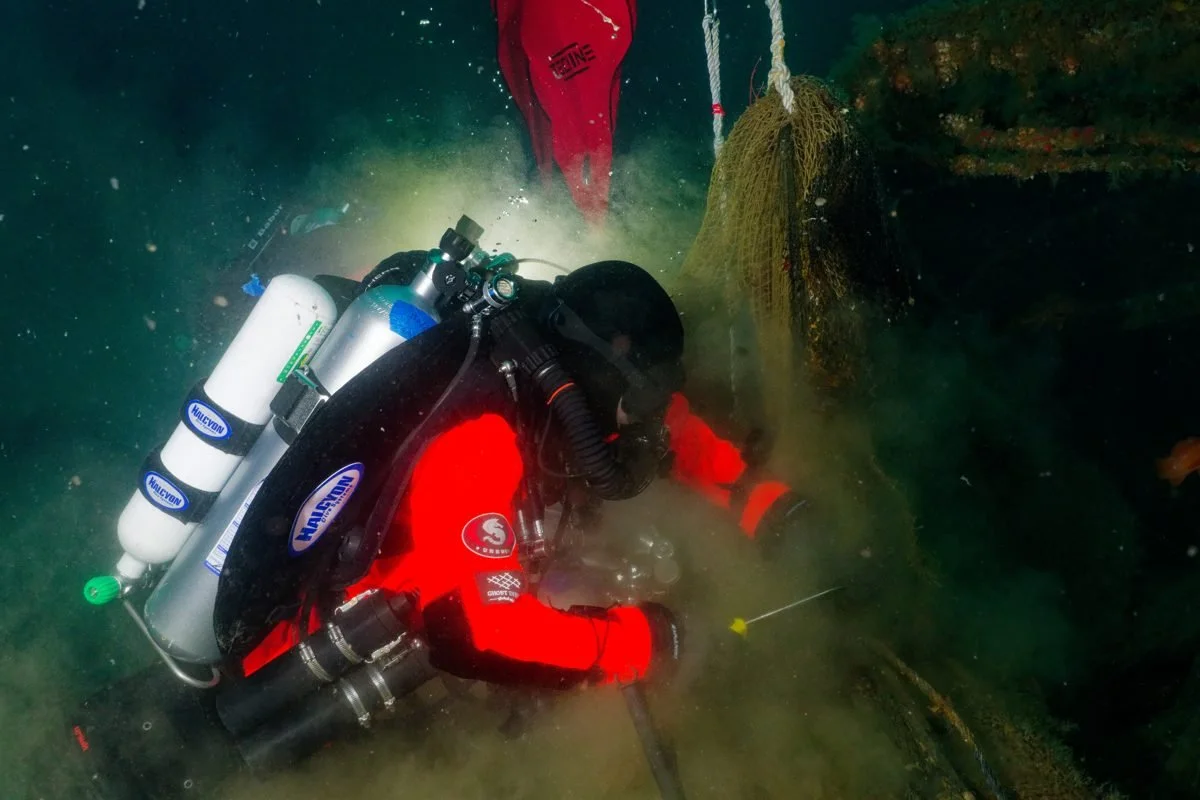
Cutting the net free and rigging it to a lift bag down on the wreck.
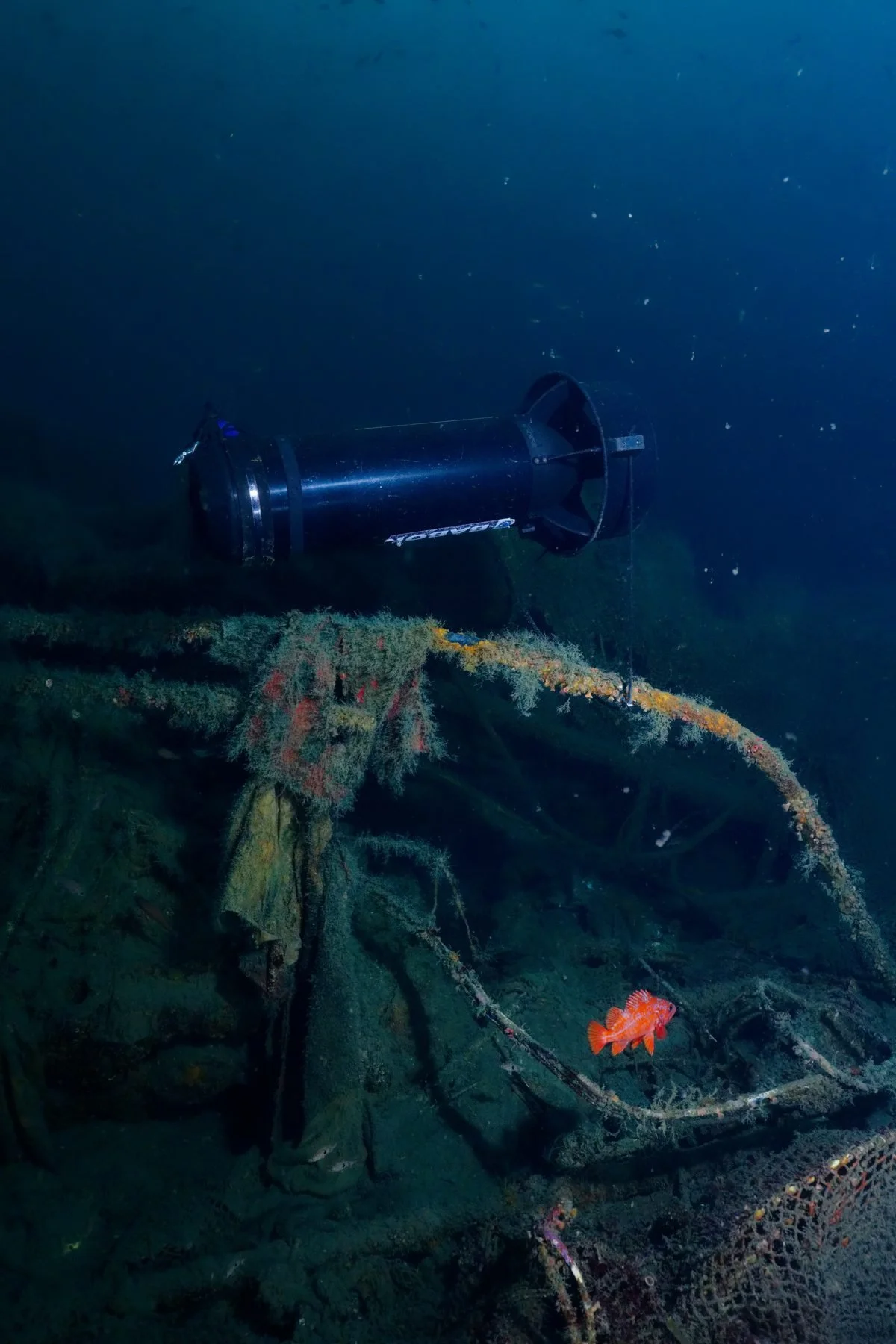
One of our scooters staged over the structure of the wreck while net blankets the wreck below.
When the net was tallied, the team had removed roughly 100 pounds, about 300 square feet, of ghost net from the site. That is 100 pounds of net that can no longer entangle and kill marine life. This haul was recovered as part of our ongoing campaign with Hyundai, and the net was delivered to Aquafil to be recycled and given a second life rather than left to fish forever on the bottom.
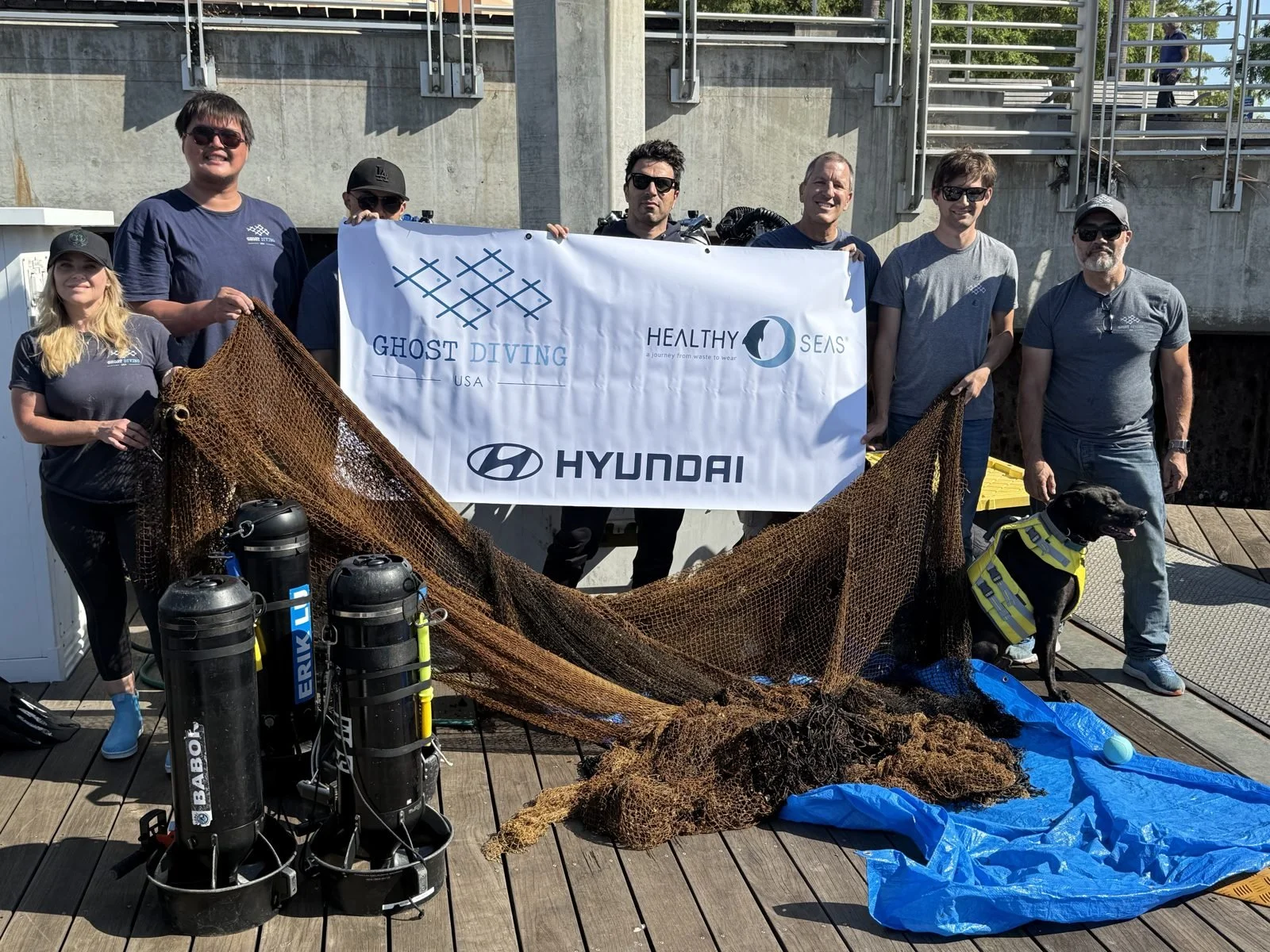
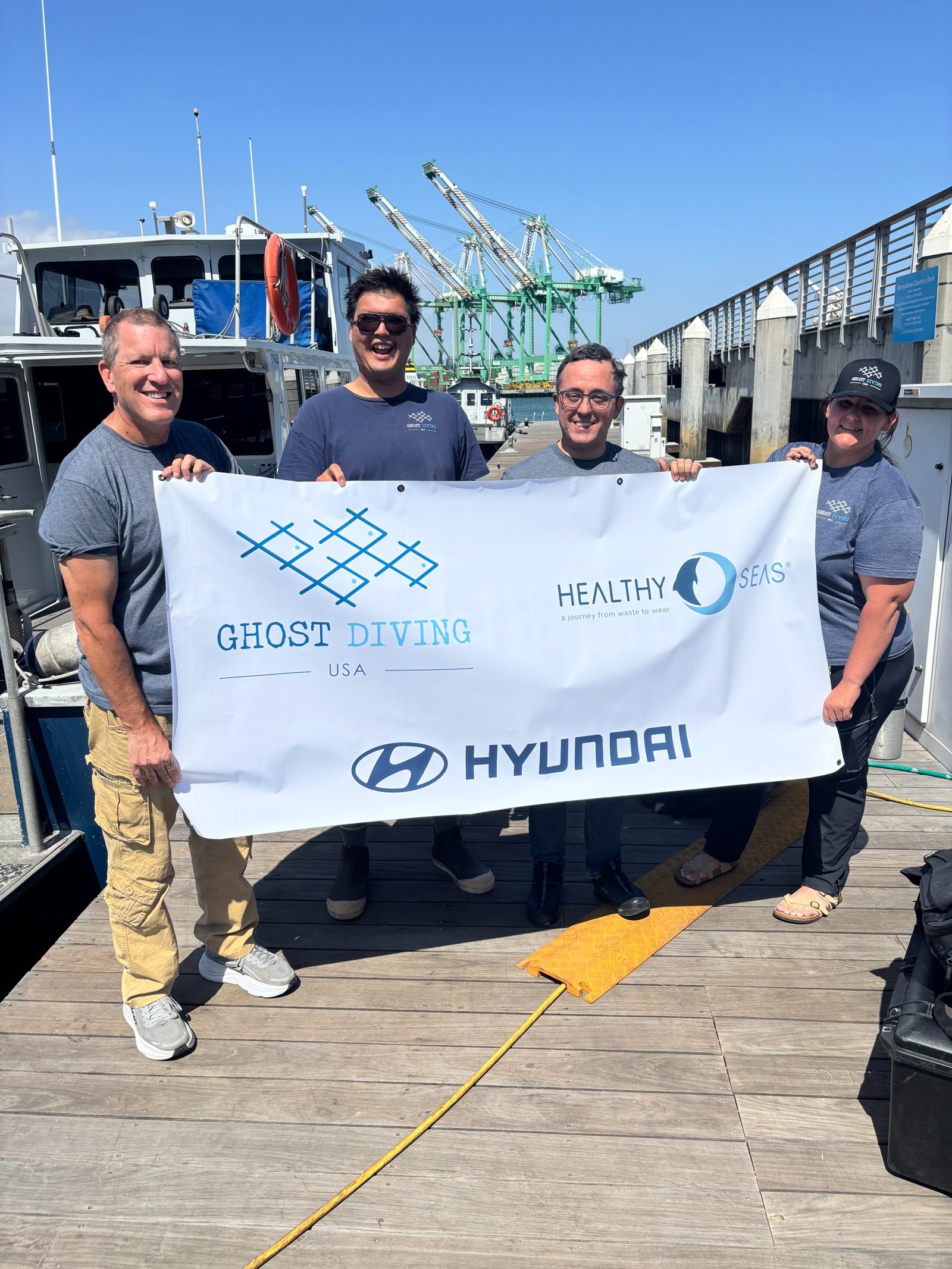
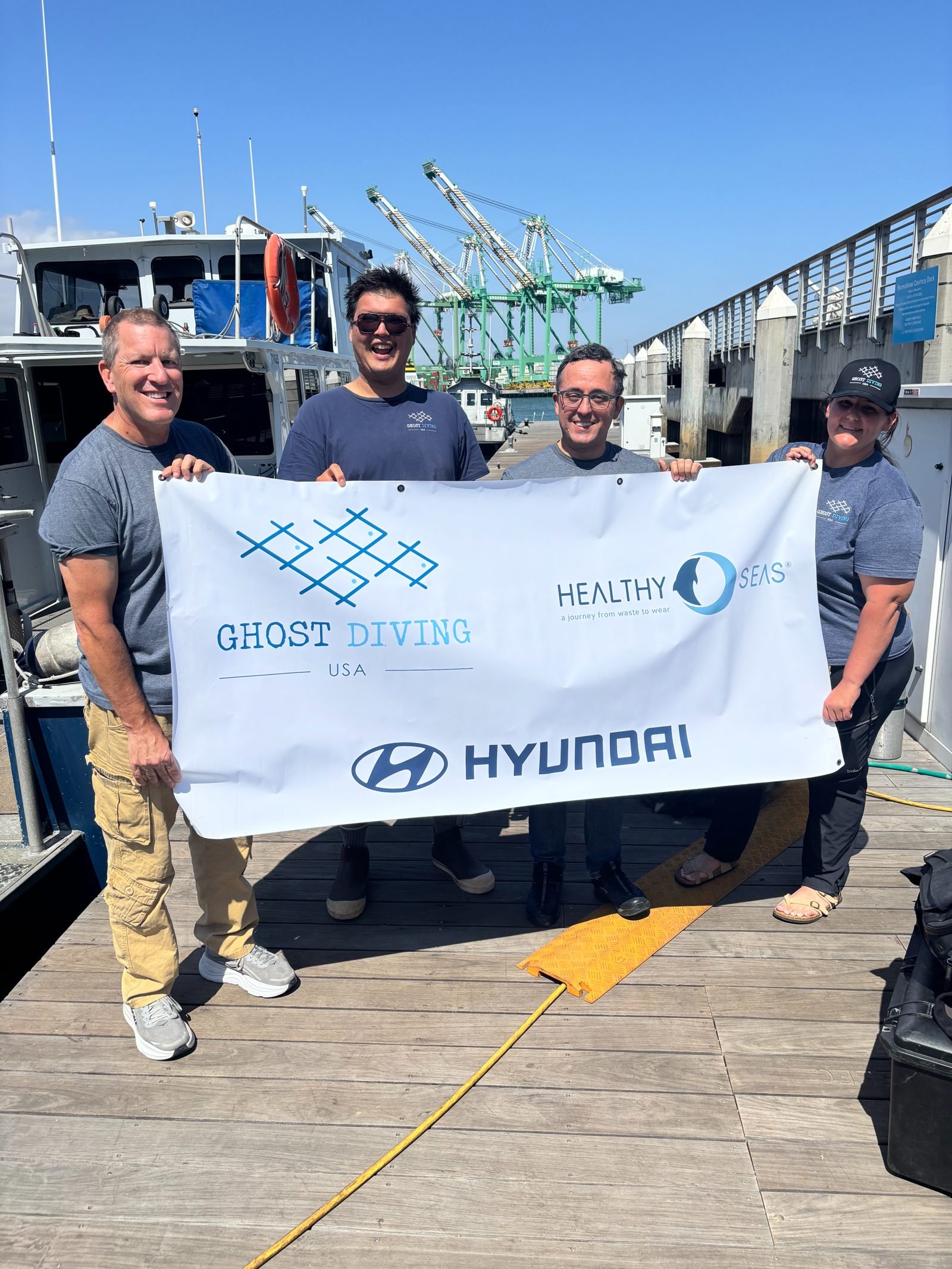
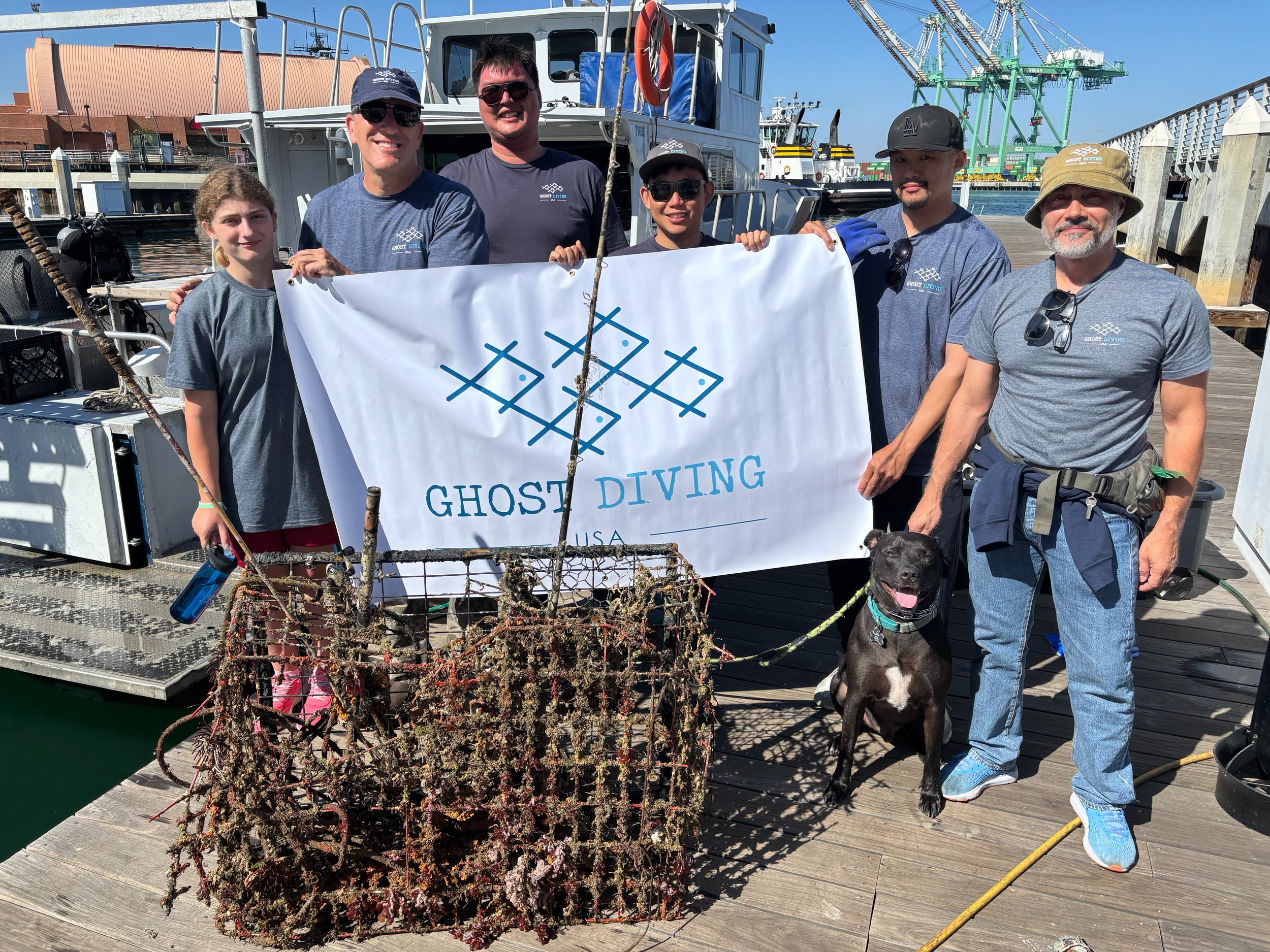
The day's haul laid out dockside — recovered net behind the Ghost Diving USA, Healthy Seas, and Hyundai banner, with the whole crew (and one dog).
A great day for the team and another meaningful dent in the ghost gear off our coast. We will be back for the Tuna Clipper.
A very special thank you to Captain Jim and the crew of the Giant Stride, and to our partners at Healthy Seas, Hyundai USA, and Aquafil for supporting our clean-up efforts.
Tuna Clipper
Location: Catalina Island
Wreck: Tuna Clipper
Teams:
Team 1: Michael Gasbarro, Andrew Hung
Team 2: Keith Chu, Juan Torres
Team 3: Jim Babor, Tianyi Lu
Surface Support: Laurie Dickson, Katie McWilliams
Mission Impact: 500 square feet of net removed, 1 hoop lobster pot removed.
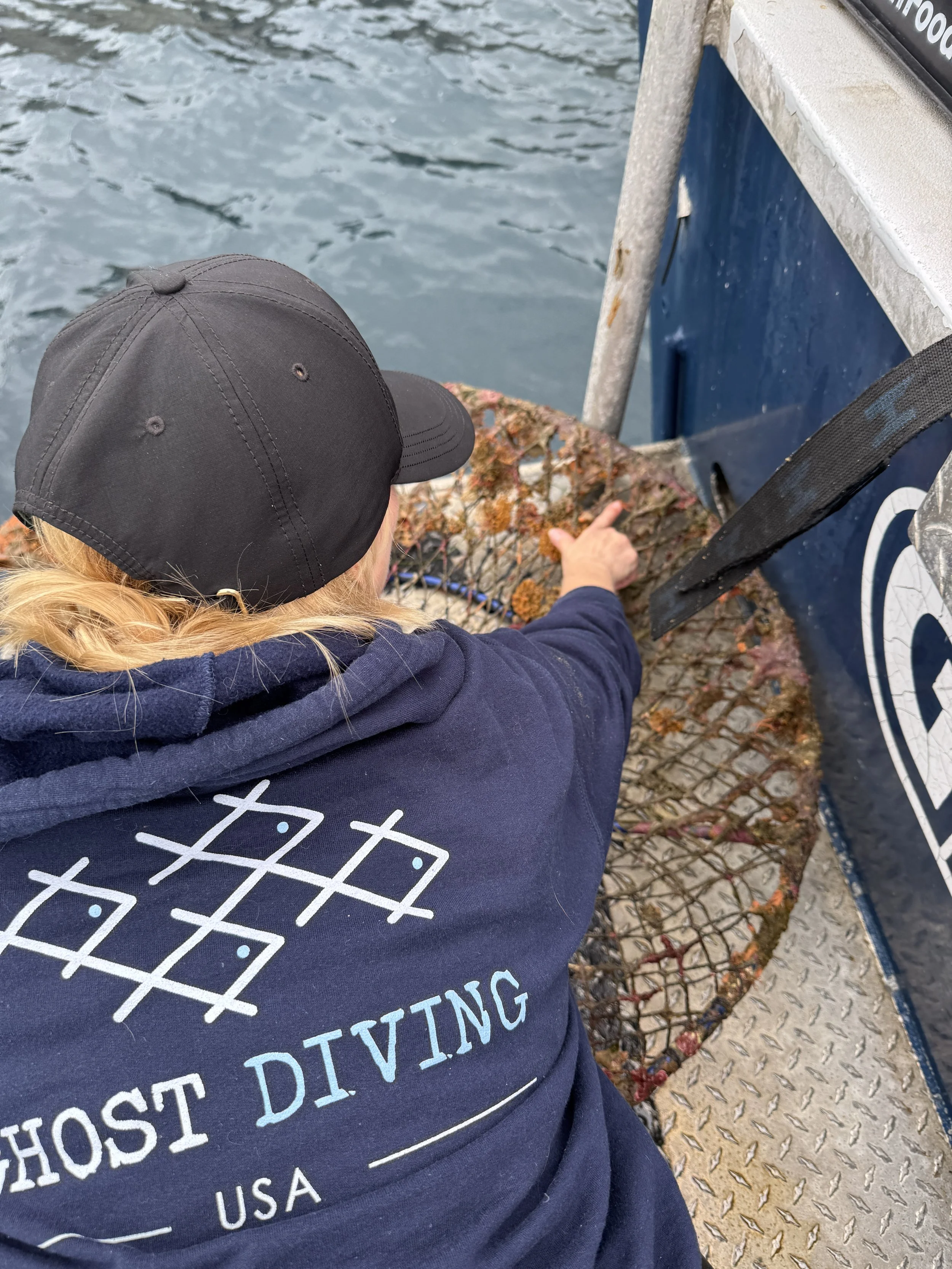
Team Ghost Diving USA dove back in at the Tuna Clipper to continue our clean up efforts. Divers were met with stunning conditions topside and below.
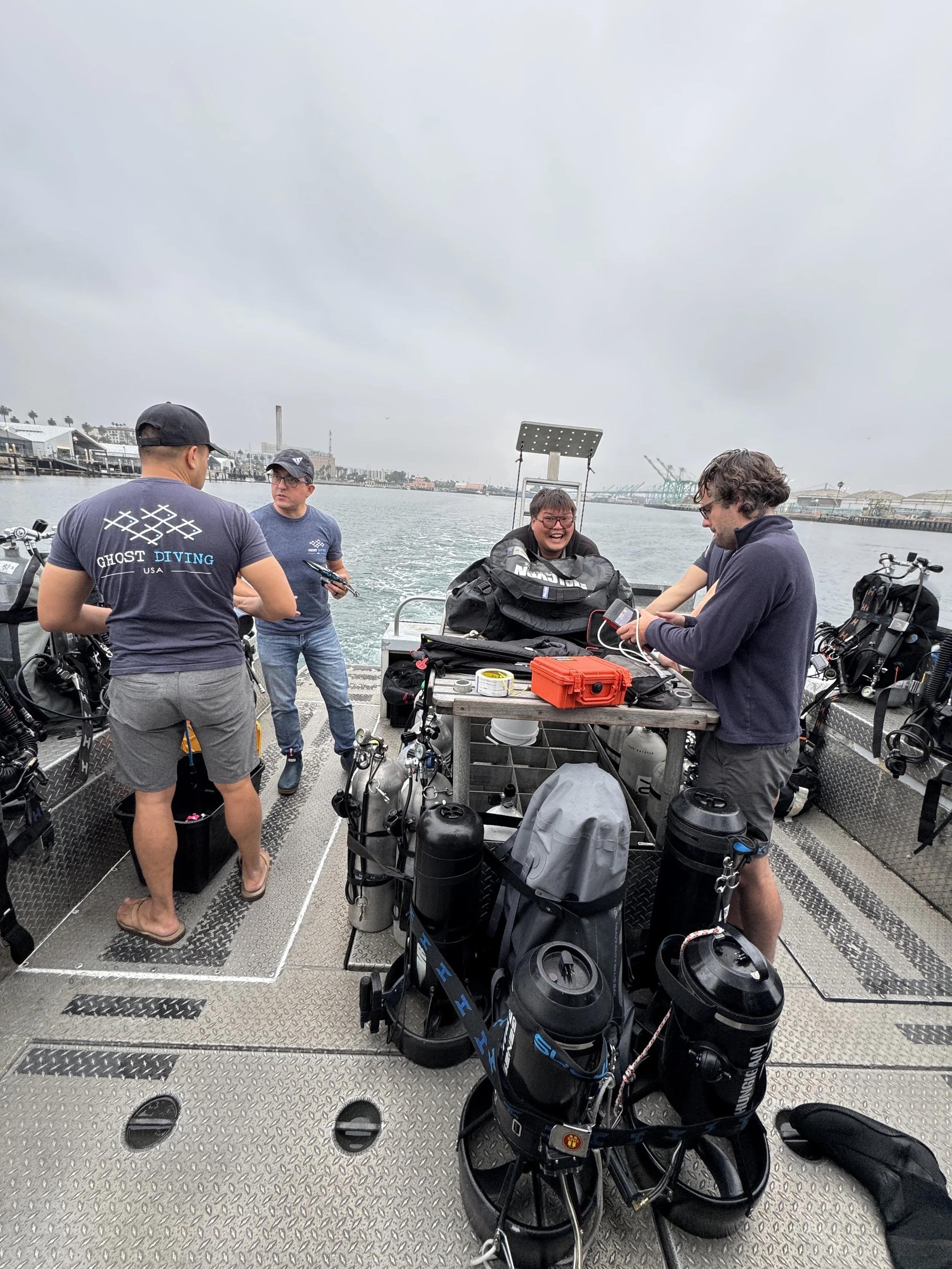
The teams opted to stagger their profiles to maximize bottom times. Team 1 was tasked with placing lift bags and jumped in first, after approximately 20 minutes team 2 dove in to document, and then finally team 3 was the cut team.
The teams were able to complete their assigned tasks with no challenges and worked collectively to remove 500 square feet of net and 1 lobster pot.
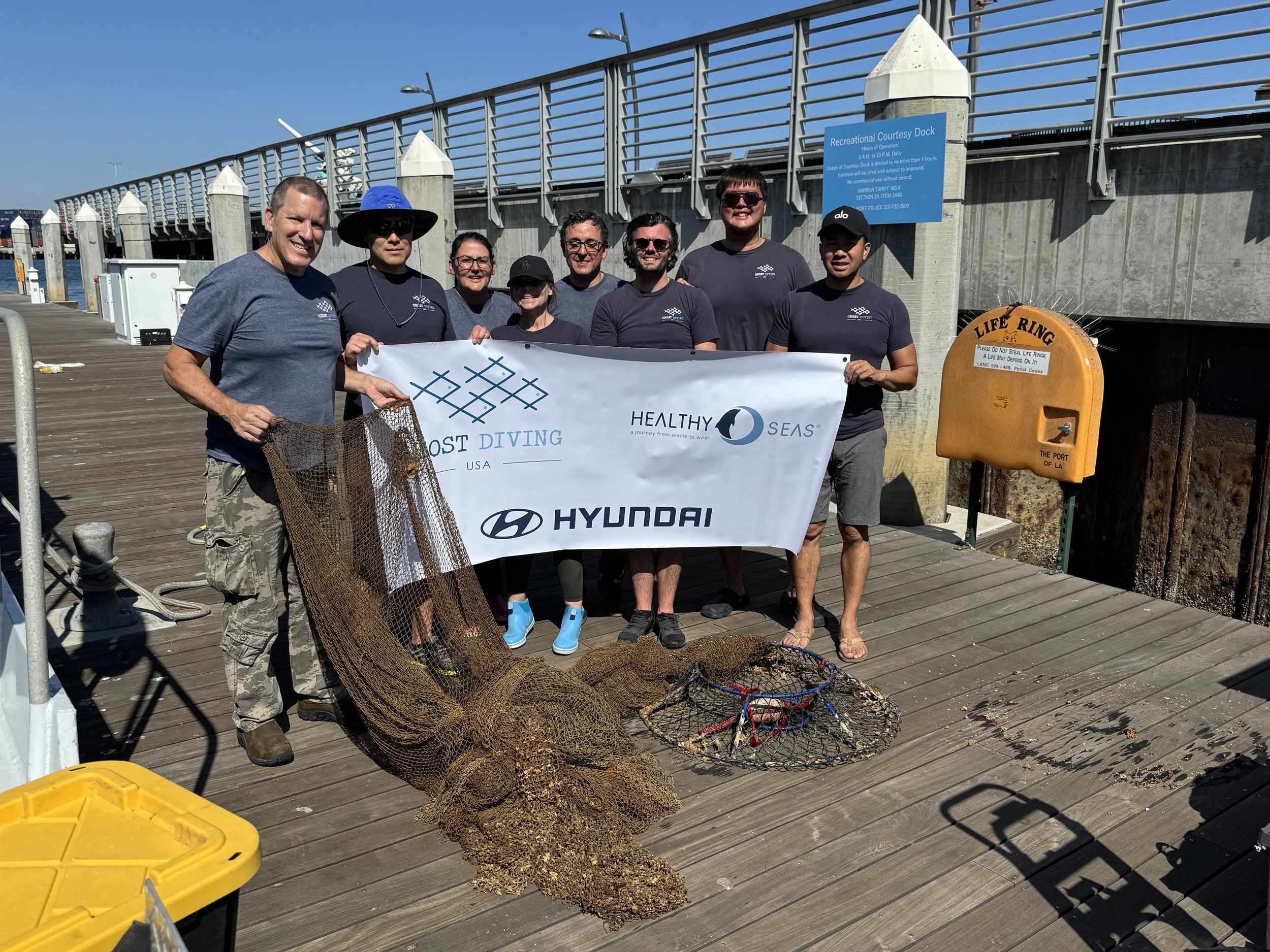
A very straight forward and successful day for the team. The recovered net and lobster pot were taken to a local artist for a project. Stay tuned for details to come!
A very special thank you to our partners at Healthy Seas and Hyundai USA for supporting our clean up efforts.

Laguna Beach
Location: Laguna Beach, California
Site: Crescent Bay, Crystal Cove, and Emerald Bay
Teams:
Team 1: Andrew Hung, Norbert Lee
Team 2: Karim Hamza, Erik Lu
Surface Support: Jim Babor, Emma
Mission Impact: 100 pounds of debris removed.
Every mission serves as a lesson for team Ghost Diving USA. The goal for this mission was to motor down the coastline to Laguna Beach and collect lobster pots reported by two of our team members, Andrew and Norbert.
The team arrived to find that water conditions were quite challenging. There was a large North to South swell that created intense current and very poor visibility. The teams searched the area for the pots. Unfortunately, after a lengthy search, the teams had to call off the search due to poor visibility.
The team opted to move to a second site. Captain Jim of the Giant Stride skillfully anchored on GPS coordinates provided by Andrew and Norbert. The teams re-entered the water. They successfully located a lobster pot, despite the challenging conditions. They were also able to find a pile of fishing debris including fishing rods that Andrew had placed while on a shore dive prior to the mission.
While the dives were challenging, team Ghost Diving USA rose to the occasion and were able to learn valuable lessons as we continue our pursuit of ghost gear.

Tuna Clipper
Location: Catalina Island, California
Wreck/Site: Tuna Clipper
Teams:
Team 1: Jim Babor, Symeon Manias, Terry Koritz
Surface Support: Angie Biggs, Jamie Mitchell, Mark Self
Mission Impact: 300 pounds of net removed.
A small but might team of Ghost Divers set out as part of the World Environment Day of Action Campaign. We headed back to the wreck of the Tuna Clipper to continue our ongoing clean-up of the site.

The plan for the day was to descend, survey the site to check the status of the clean-up effort and, of course, remove more net. As the team descended, they found a large section of net out in the sand. As the team briefly surveyed the wreck, they found that there were multiple animals ensnared by the net. These animals included a cormorant, multiple fish, and a seal that was at an advanced stage of decomposition. The animals were documented.

The team opted to remove the large section of net out in the sand. The team used 5 lift bags to lift the net and were able to send all the net to the surface. They completed their decompression obligation and returned to the boat.
The surface crew, with help from Captain Galvin, were able to get all the net on board. The team was very happy to be part of a global initiative that brings awareness to the needs of our environment and empowers everyone to be part of the solution.
The nets were taken to a local partner to be upcycled into sustainable materials.

UB-88
Location: San Pedro, California
Wreck/Site: UB-88
Teams:
Team 1: Jung Hseih, Norbert Lee
Team 2: Karim Hamza, Nir Maimon
Team 3: Symeon Manias, Curtis Wolfslau
Surface Support: Angie Biggs, Laurie Dickson
Mission Impact: 800 pounds of net removed.
Team Ghost Diving USA returned to the UB-88 wreck to further our clean up of this historic wreck. Teams planned to work most efficiently by staggering their dive times. Team 1, Jung and Norbert, were tasked with setting lift bags, preparing the sections of net to be cut, and begin the net cutting process. Team 2, Karim and Nir, descended as Team 1 began their decompression schedule. They were focused on cutting net in the designated areas prepared by Jung and Norbert. Team 3, Symeon and Curtis, descended with Karim and Nir and documented the net cutting.
Our divers are diligent about checking the nets for trapped sea life. Unfortunately, in checking the nets, we always know that there is a possibility that we will find something that didn’t survive it’s encounter with the nets. Unfortunately, we found a harbor seal. The harbor seal had clearly been ensnared in the net for quite awhile given the state of decay.
While this is sad, documenting these findings is an important part of our work. While we always hope that we do not find something to document, these findings validate why our work is important and must continue.


Cabrillo Marine Aquarium Earth Day
We had the opportunity to return to the Cabrillo Marine Aquarium for their Earth Day event! The event was well attended and included incredible exhibitors including Cal State Long Beach’s Shark Lab, The Jane Goodall Foundation, and the American Cetacean Society, to name a few. The event was well attended and included interactive activities for children including crafts and games. The Aquarium also had various informational sessions throughout the day including about the famous grunion run that was also happening that weekend.
It was a great day to connect with the community and celebrate our home planet!

LA County Sanitation District Earth Day
Team: Angie Biggs, Keith Chu, Laurie Dickson, Jung Hseih, Norbert Lee
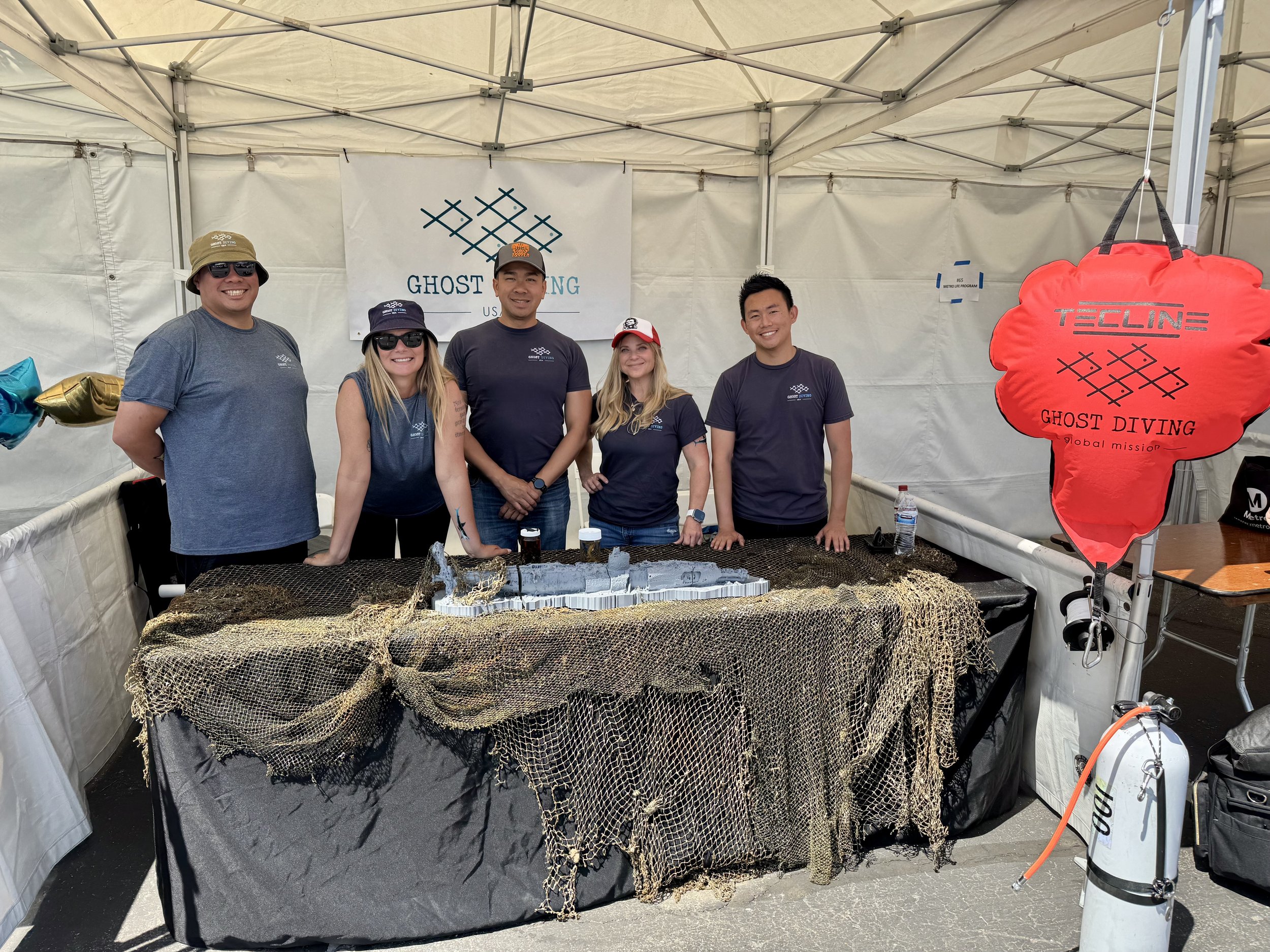
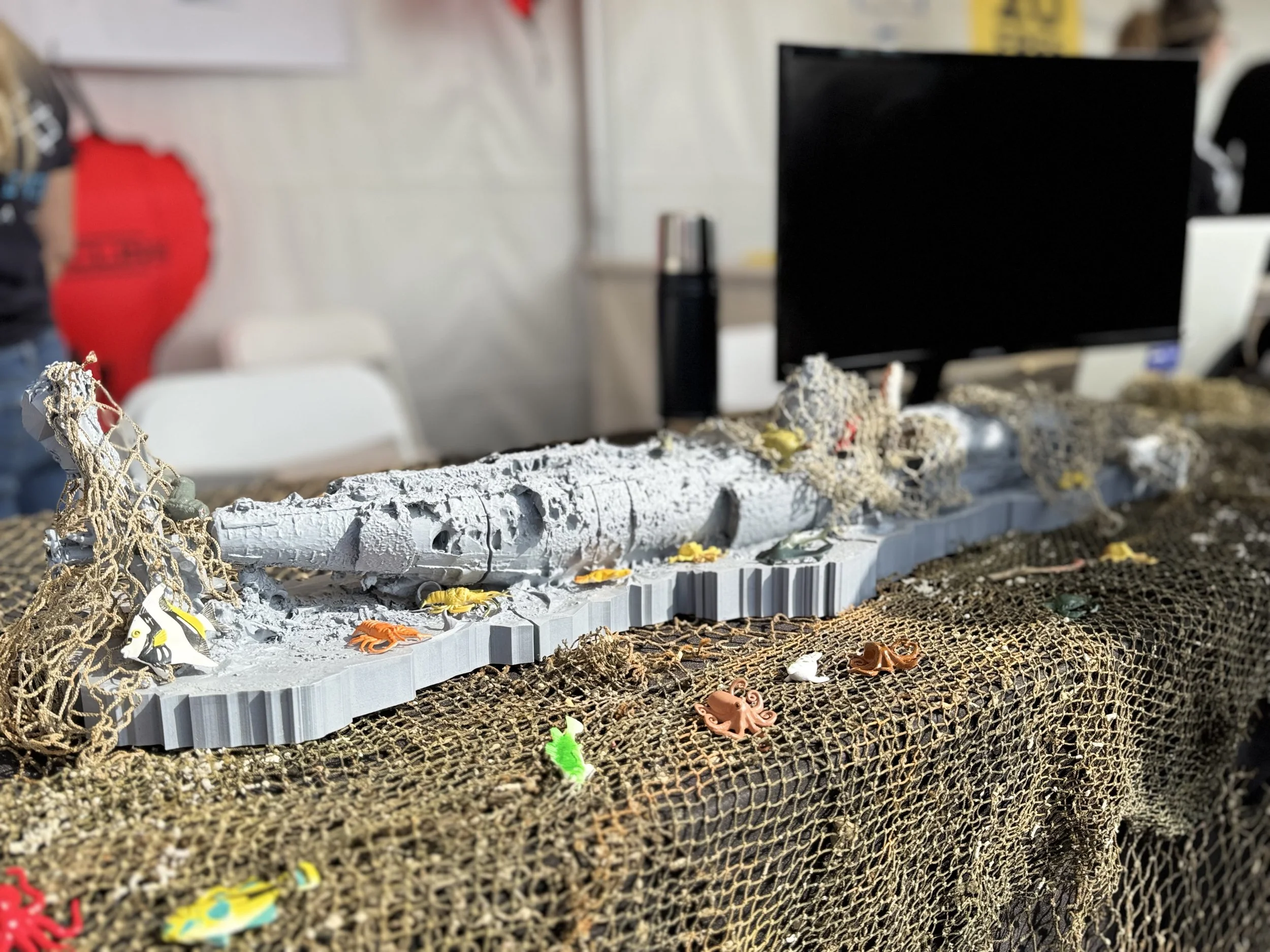
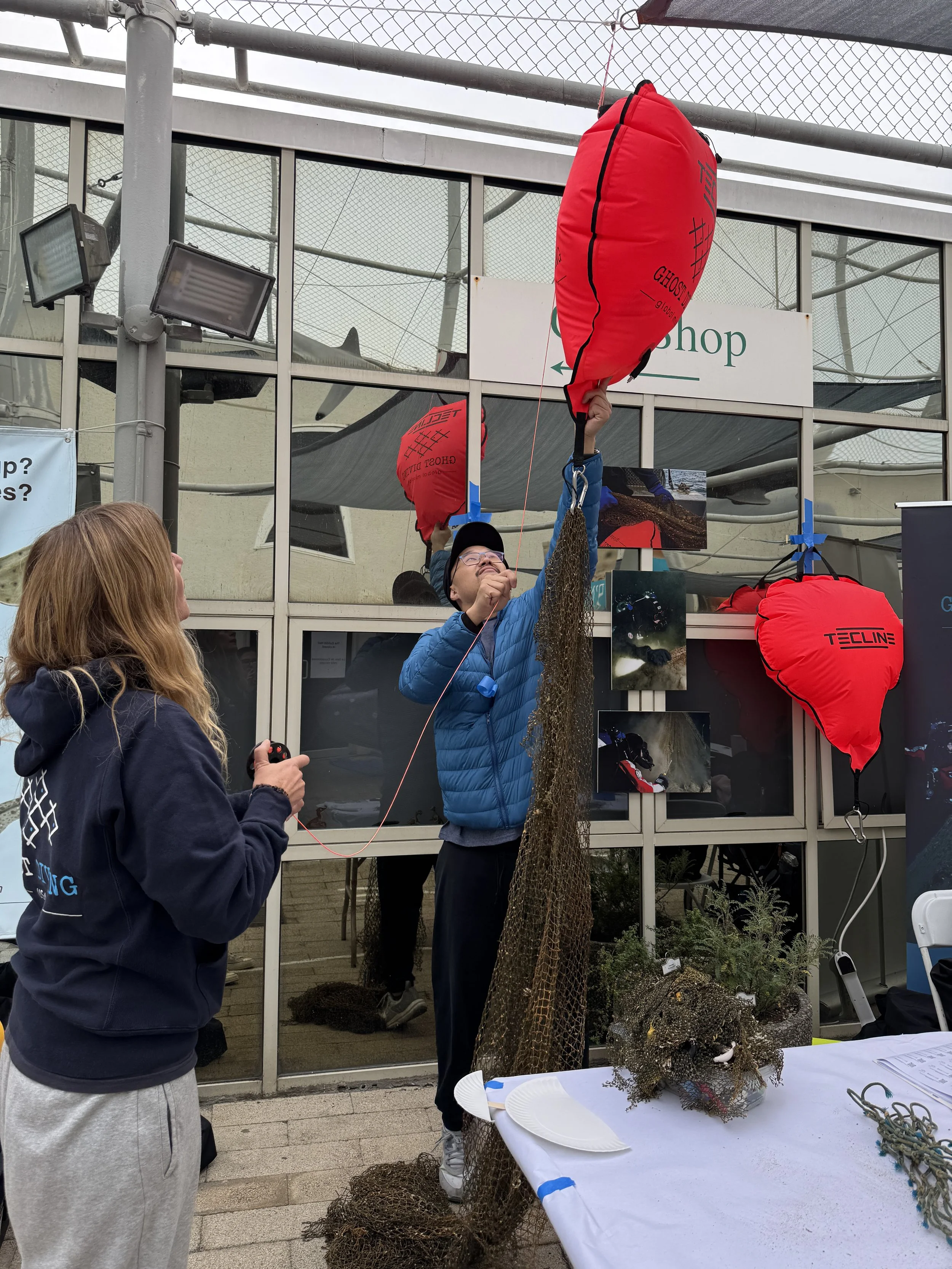
Our team was thrilled to return to the LA County Sanitation District’s Earth Day event. We hosted an outreach booth where community members were able to rescue an animal, inflate a lift bag, look at the 3D model of the UB-88, and examine preserved samples of marine life and look at various pictures.
As always, a very special thank yout o our volunteers who make these events possible and do a fantastic job of sharing their experiences and connecting with the community!

Emerald Bay
Location: Laguna Beach, California
Wreck/Site: Emerald Bay
Teams:
Team 1: Andrew Hung and Norbert Lee
Mission Impact: 1 cage style lobster trap located and marked using GPS, additional survey completed.
Our team is truly special because our divers are relentless in their pursuit of marine debris. 2 of our team members, Andrew and Norbert, completed a survey of a local diving hot spot, Emerald Bay. There are a few things that make this site unique. First, it is a shore dive which means that divers gear up at their cars and walk to the entry point with all of their gear. Then, once they get to the beach, they have to walk across the sand (with all the heavy gear!), get into the water through the waves, put their fins on just outside of the break zone (where the waves crash), and then swim to their descent point. In summary: it’s a workout! Laguna Beach is also unique in that the beaches are a series of coves. For divers, this means that you can (theoretically) dive 2 coves or more coves in one dive, assuming you have a diver propulsion vehicle (DPV).
The dive plan for the day was for Andrew and Norbert, using their DPVs, to survey multiple coves for lobster pots and any other debris and collect GPS coordinates using the GPS buoy.
Unfortunately, the conditions did not allow the team to survey multiple coves. However, they were able to locate and mark one lobster pot for future collection.

UB-88
Location: San Pedro, California
Wreck/Site: UB-88
Teams:
Team 1 - Jung Hseih, Norbert Lee
Team 2 - Karim Hamza, Mark Self
Team 3 - Jim Babor, Curtis Wolfslau
Surface Support: Laurie Dickson, Katie McWilliams
Mission Impact: No net collected
Team Ghost Diving USA returned to the UB-88 aboard the Giant Stride. When we concluded our UB-88 project, we found that there was still some net to be cleaned up and there was some steel cable that needed to removed.
Divers, armed with heavy duty bolt cutters, planned to try the cut the cables with the bolt cutters and continue their work removing the remaining nets. We arrived to the site, the anchor dropped and Jung and Norbert geared up to jump in. After getting in, Jung and Norbert noted a strong surface current. They opted to drop below the surface, hoping the current would go away as they got deeper.
Bad news, the current blew them away from the boat in the opposite direction. The team and Captain Jim sprang into action and sent a current line out to them. Jung and Norbert continued to try and get back to the boat using their diver propulsion vehicles aka scooters and kicking. They were not making progress getting back to the boat. They grabbed the current line and the team worked to pull them in. Once they were safely back on board, the team opted to wait for a little bit to see if the current would die down.
Unfortunately, it did not. But, it was a ton of fun to hang out on the boat with the team members and wait. Ultimately, the team opted to cancel the diving for safety reason and headed home.
Until next time, UB-88.

Avalon Harbor Cleanup
Location: Avalon, Catalina Island, California
Dive team: Jim Babor, Angie Biggs, Sean Canullas, Karim Hamza, Andrew Hung, Shane McWilliams, Daniel Pio
Shore team: Alysha Acosta, Katie McWilliams
The Avalon Harbor Cleanup is an annual event in Southern California. The purpose of the event is to raise funds for the USC Catalina Hyperbaric Chamber. The chamber is run by highly trained volunteers. It is the only chamber that stands ready 24 hours a day, 7 days a week, 365 days a year ready to treat injured divers. There is something special about the Avalon Harbor Cleanup. It is the first of 2 fundraisers that support a year of chamber operations. It provides a sense of purpose for participants. It also serves as an annual reunion for the diving community. While Southern California is large, the Southern California diving community does a great job of making it feel smaller and friendlier. This event also gives everyone the opportunity to give back to the island that gives us all so much. Almost everyone has memories of diving the Casino Point Dive Park and a favorite Catalina dive site.
This year Ghost Diving USA had a booth in Avalon during the event and our team supported with heavy item recovery from aboard the Giant Stride. On shore, it was exciting to watch the Giant Stride come into the harbor. It was fun to wave to our friends from the beach.
It was a very busy day for both our shore and dive team. The shore team had the opportunity to connect with other dives and passersby. In talking to the visitors, it was interesting to hear the various experiences with marine debris. Many of the visitors shared about trash they find at their favorite dive sites or the balloons that they see floating on the surface as they make the crossing to Catalina Island.
As sad as it is that we all have experiences with marine debris, it is refreshing and inspiring to connect through a shared passion for cleaning up marine debris.
We had our model of the UB-88 on display. It was great to discuss the success of our UB-88 project. As we talked to people, it was interesting to see how many people were unaware of the UB-88 wreck and its history. It adds a unique texture to the fabric of the history of Southern California wrecks.
The shore team got to say a brief hello to the dive team when they brought a boat battery and other debris to the shore to be counted.
In talking to all of the participants, they had a great time and enjoyed a day that serves to build community and camaraderie.
We look forward to next year!
Whale Fiesta
Location: Cabrillo Marine Aquarium, San Pedro, California.
Team Members: Angie Biggs, Sean Canullas, Laurie Dickson, Michael Gasbarro, Erik Lu, Katie McWilliams, Shane McWilliams
Ghost Diving USA had an exciting opportunity to be an exhibitor at the Cabrillo Marine Aquarium’s Whale Fiesta! The purpose of the event is to educate the community about the incredible whales that can be seen off of the California coast.
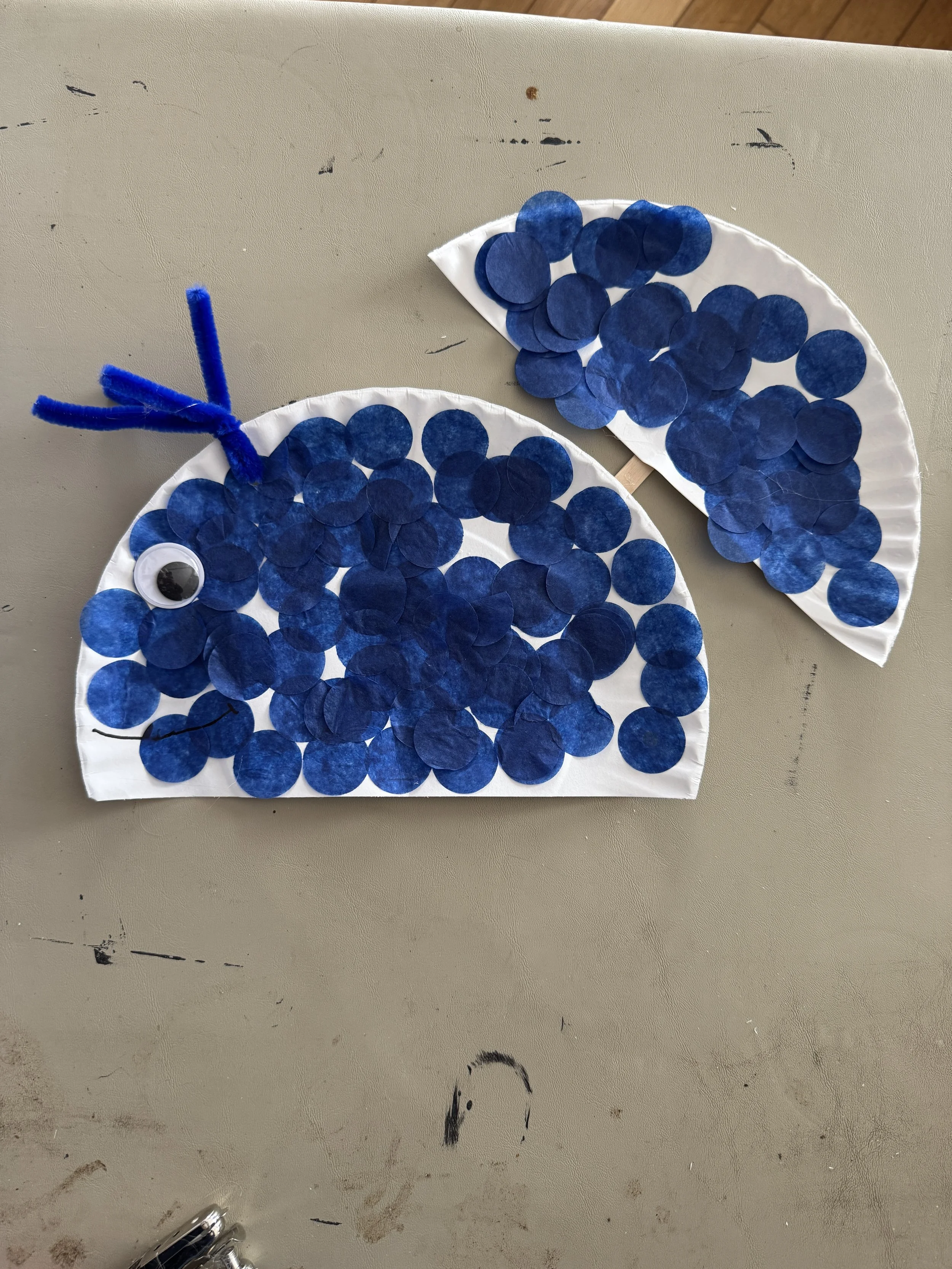
Team members were quick to set up the booth and activities for the day. In honor of Whale Fiesta, we prepared a whale craft for the children attending the event in addition to our usual activities.
The day was a ton of fun! Our booth was next to a table of whale baleens and bones and across from an inflatable humpback whale. Everyone that we spoke to at the event was very excited to talk to us and ask questions about our work. They were surprised to hear about the prevalence of the problem. It was a great day to connect with the community, create art, and enjoy an incredible aquarium. We look forward to next year!
Special thank you to Erik Lu for this video of the day!

Project: UB-88
Project UB-88 has finally come! There is excitement and anticipation circulating amongst the team. Years of training, commitment, hard work, and fun dives have lead our divers to this mission. A year of preparation has lead the team to this moment. This mission was so big it required 2 boats and a minimum of 3 surface support personnel each day. UB-88 brings a unique challenge. She sits in 200 feet of seawater in the mouth of the San Pedro Harbor. This dive is a deep technical dive and requires a high level of training and experience. In addition to the challenge presented by the depth of the wreck, it sits in the middle of an active shipping channel. When you are anchored by the UB-88, you can see the Catalina Express zip across the channel, large freighters waiting to enter the port, and various smaller vessels coming and going like cars on a highway. This presents a unique challenge for divers for several reasons. First, being in the middle of the channel, there’s no structure to protect the area from conditions such as currents or swells. Next, if divers surface away from the wreck or away from the dive boat, there are several safety concerns. Larger vessels can’t see them, if the current is strong they may need assistance getting back to the boat, or they can become disoriented and struggle to find the dive boat because of conditions below the surface. For all of these reasons, we give a very special thanks to Captain Jim Simmerman of the Giant Stride and Captain Kevin Bell of the Bottom Scratcher and their crews for working collaboratively with our surface support crews, and ensuring the safety of our divers.
Day 1 - 12/16/2024
Divers:
Net handling divers: Jim Babor, Michael Gasbarro, Karim Hamza, Norbert Lee, Symeon Manias, David Watson, Curtis Wolfslau
Safety divers: Shane McWilliams, Daniel Pio
Surface support: Angie Biggs, Jamie Mitchell, Katie Papac
Surface documentation: Kian Farin
The objectives for day 1 were to complete an assessment of the net to ensure it matched our notes from the last survey and place lift bags. Norbert, Director of Scientific Studies, focused on taking baseline data for his study that examines the impact of the net on the wildlife that lives around the wreck.
Day 1 was a success! Given the logistical requirements of the divers due to the depth, the volume of net, and the significant attention to detail required for this site, the divers placing lift bags and updating survey notes is a significant step. By updating survey notes, divers can give the Day 2 teams a thorough and accurate briefing for the next day. By placing the lift bags the teams are able to return and start cutting the nets.
Day 2 - 12/17/2024
Divers:
Net handling divers: Jim Babor, Michael Gasbarro, Karim Hamza, Norbert Lee, Mark Self, David Watson, Curtis Wolfslau
Safety divers: Jamie Mitchell, Rene Tetter
Surface support: Angie Biggs, Shane McWilliams, Katie Papac
Surface documentation: Kian Farin, Zachary Rich
Day 2 came with new objectives. These objectives included rehoming some metridiums (a type of anemone) off of the net and to a safe area for them to grow, the placing of more lift bags, and teams were to begin cutting nets.
Day 2 was a success! Divers were able to remove approximately 500 pounds of net! More excitingly, they were able to save some fish and crabs that were trapped in the nets in the sand. Divers left some lift bags for the Day 3 teams to allow for efficient workflow the following day.
A very special thank you to Leanne Suter of ABC 7 News who ran a story about the project that aired today. You can find the story here.
Day 3 - 12/18/2024
Divers:
Net handling divers: Jim Babor, Michael Gasbarro, Karim Hamza, Norbert Lee, Tianyi Lu, Symeon Manias, Curtis Wolfslau
Safety divers: Shane McWilliams, Daniel Pio
Surface support: Angie Biggs, Laurie Dickson, Jamie Mitchell, Juan Torres
Day 3, half way through the project! The goal today was to clear the torpedo tube of all the of the nets that are entangled on it. In doing this, the wreck of the UB-88 will be free of the nets that have haunted her. There will still be nets in the sand surrounding the net but this will be a significant and exciting accomplishment for the team if they are able to meet the objective.
Our team not only met the objective, they absolutely smashed it! Not only did the team free the UB-88 of the nets, the team was able to remove 1,500 pounds of net!
This is significant for a number of reasons. First, this is 1,500 pounds of net that can no longer ensnare and kill marine life. Next, the net will no longer have the opportunity to destroy the artificial reef the UB-88 has become. Finally, this is the largest net haul in GDUSA history!
Well done to the team! A special shout out to the surface support and safety diving teams that worked together to secure the 1,500 pounds of net to the Giant Stride!
Day 4 - 12/19/2024
Divers:
Net handling divers: Jim Babor, Kian Farin, Jung Hseih, Norbert Lee, Tianyi Lu, Symeon Manias, David Watson
Safety divers: Jamie Mitchell, Rene Tetter
Surface support: Angie Biggs, Laurie Dickson, Shane McWilliams
Special guests: Courtney Griffith (conservation artist), Erin Stone (journalist, LAist)
Day 4 finds our team excited to dive back in after a massively successful Day 3! Today’s objectives include a final survey and cleaning of the torpedo tube and address any additional pieces of net that could actively fish. The next objective is to evaluate the net that is in the sand and what will need to be done to remove it. Then, there are steel cables that the team needs to evaluate and determine what they need to do to appropriately remove the cables.
Another successful day for the team! They were able to get the net in the sand collected into one area which will facilitate efficient removal. The team does still need to find the correct tool to address the steel cables but they were able to gather good information to support an informed decision about strategies. There was a hint of disappointment when the team realized and accepted that the clean up will not be completed in 5 days. Rather than being upset or chalking it up as a loss, the team walked away happy to have made a significant dent in major project.
A very special thank you to our special guests Courtney and Erin. By spreading the word about our work and why it matters, you not only support GDUSA, but you empower the community to choose the health of the ocean.
Courtney is a conservation artist that uses marine debris to discuss conservation and the human connection to the environment. From the net she was given, she created an installation called Cruel Immorality. You can learn more about it and the rest of Courtney’s work here.
Erin is a Climate Emergency Reporter with LAist. Erin’s passion lies in educating the public about the shifting climate and helping the public to understand how and why this shift is happening. Erin joined us today and spoke with some of the members of our team to prepare a story about the UB-88 project and our work in general. You can learn more about Erin here and read her story of the UB-88 project here.
Day 5 - 12/20/2024
Divers:
Net handling divers: Kian Farin, Jung Hseih, Norbert Lee, Tianyi Lu, Nir Maimon, Mark Self, Curtis Wolfslau
Safety divers: Daniel Pio, Yury Velikanau
Surface support: Jim Babor, Angie Biggs, Laurie Dickson, Shane McWilliams, Jamie Mitchell
Team Ghost Diving USA made it to the final day of the project! Today’s objectives include the scientific team (Norbert and Jung) taking baseline data after net removal and the other net handling teams are to clean up and remove any other miscellaneous pieces of net and continue working on strategies for the steel cables.
The teams completed all objectives and celebrated leaving the wreck at peace with the remaining net accounted for and prepared for efficient removal.
After returning to the dock, the team members had lunch at a local restaurant. The pride and accomplishment is palpable around the table. The team celebrated the teamwork and perseverance that made this project possible. It is truly humbling to sit at a table with a group of people who just completed 5 days of very challenging diving and rigorous surface work. The truly inspiring part of looking around this table is that not only are they a team, they are a team of volunteers driven by passion. They are friends that support each other and push each other to rise to the occasion.
As with any project there are successes, there are things that could have gone better or simply differently. As a whole, this project is a win for team Ghost Diving USA and a large success in our pursuit of the ghost nets.
Congratulations to the entire team! You’ve made an incredible impact!